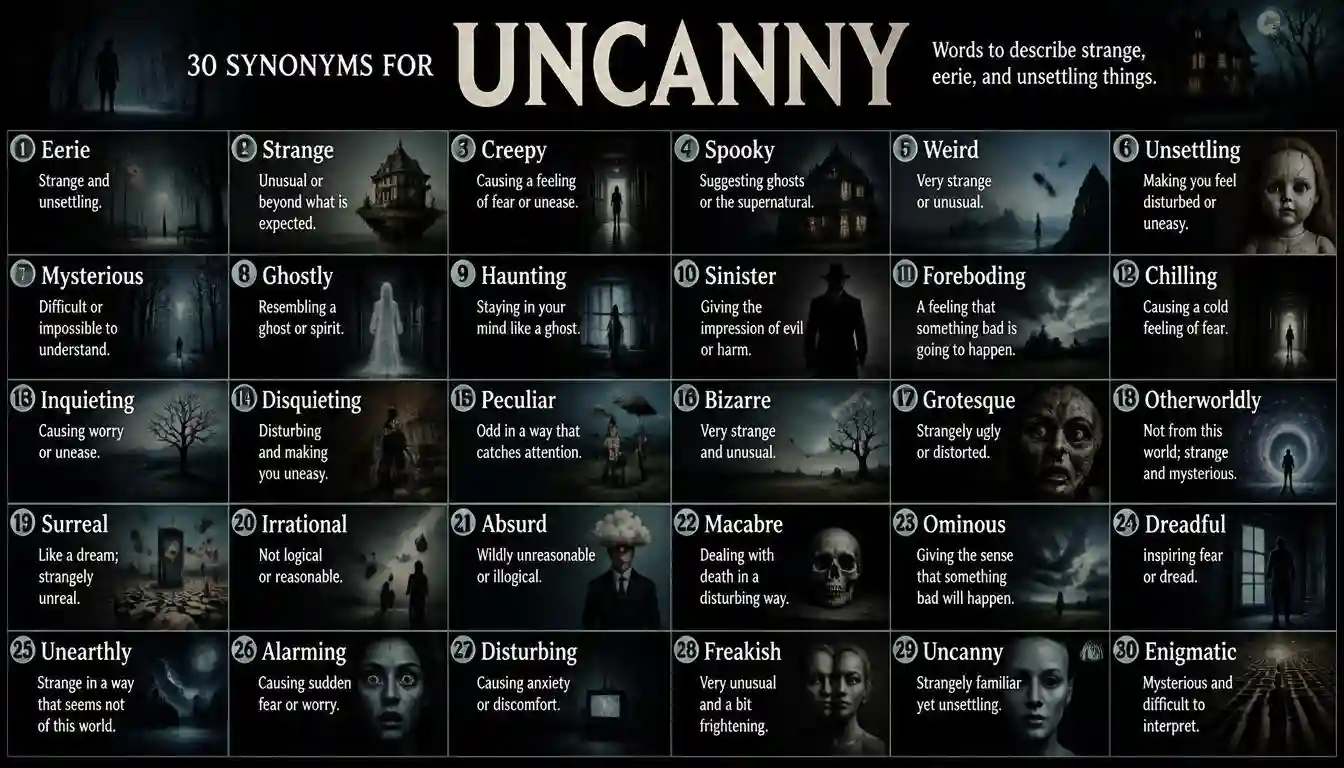
Synonyms for uncanny include eerie, strange, creepy, spooky, weird, unsettling, and mysterious. Uncanny describes something so strange that it feels odd, a little scary, or hard to explain. You may feel it when something seems both familiar and wrong at the same time. Knowing these words helps you pick the right one for each moment.
Table: Synonyms of Uncanny
| Synonyms for Uncanny | Meaning |
| Unnatural | Not how things normally are |
| Ghostly | Like a ghost or spirit |
| Bizarre | Very strange and hard to believe |
| Haunting | Strange in a way that stays in your mind |
| Spectral | Like a ghost or shadow |
| Otherworldly | Seeming to come from another world |
| Freaky | Strange in a way that startles you |
| Peculiar | Odd or different from what is normal |
Definition of Uncanny
- Definition: Uncanny means strange in a way that feels eerie, odd, or hard to explain.
- Example: The old doll had an uncanny look, as if it was watching us.
- Intensity and usage: It sits in the middle to high range of strange. It is stronger than “odd” but softer than “terrifying.”
- Usage note: It describes things, feelings, places, and events. Short phrases: “an uncanny silence,” “an uncanny feeling,” “uncanny timing.”
Etymology of Uncanny
- Origin: It comes from the root can, from Old English cunnan, which means “to know” or “to be able.”
- Path to English: It grew in Scots and Northern English, where canny meant “wise” or “safe.”
- Time period: Uncanny appeared in English in the late 1500s.
- Original sense today: The old sense was “unsafe” or “not to be trusted.” Today it mostly means “strange and eerie.”
Word Formation of Uncanny
- Root word: canny comes from can, which means “to know” or “to be able.”
- Prefix and suffix: un- means “not.” -y forms a describing word.
- Literal sense: “Not safe” or “not known well.”
- Related English words: can, canny, cunning, and uncouth.
30 Synonyms for Uncanny
1. Eerie (Adjective)
Meaning: Eerie means strange and a little scary in a quiet way.
- The empty school felt eerie at night.
- An eerie mist covered the lake.
2. Strange (Adjective)
Meaning: Strange means not normal or not what you expect.
- She heard a strange sound in the hall.
- It is strange that the door opened by itself.
3. Creepy (Adjective)
Meaning: Creepy means strange enough to give you a shiver of fear.
- The creepy house stood at the end of the road.
- He gave me a creepy smile.
4. Spooky (Adjective)
Meaning: Spooky means strange and scary in a ghostly way.
- We told spooky stories by the fire.
- The woods looked spooky after dark.
5. Weird (Adjective)
Meaning: Weird means very odd and hard to explain.
- I had a weird dream last night.
- It was weird how quiet the street was.
6. Unsettling (Adjective)
Meaning: Unsettling means strange enough to make you feel uneasy.
- The movie had an unsettling ending.
- There was an unsettling calm in the room.
7. Mysterious (Adjective)
Meaning: Mysterious means strange and hard to understand.
- A mysterious letter came in the mail.
- The mysterious light vanished at dawn.
8. Unnatural (Adjective)
Meaning: Unnatural means not how things normally are, which feels wrong.
- The room had an unnatural chill.
- The dog made an unnatural howl.
9. Ghostly (Adjective)
Meaning: Ghostly means like a ghost, which gives a strange, eerie feeling.
- A ghostly figure stood in the fog.
- We saw a ghostly glow in the window.
10. Bizarre (Adjective)
Meaning: Bizarre means very strange and hard to believe.
- It was a bizarre end to the day.
- She told us a bizarre tale.
11. Haunting (Adjective)
Meaning: Haunting means strange and eerie in a way that stays in your mind.
- The song had a haunting sound.
- He could not forget that haunting face.
12. Spectral (Adjective)
Meaning: Spectral means like a ghost or shadow, with an eerie look.
- A spectral shape moved across the wall.
- The moon gave the yard a spectral glow.
13. Otherworldly (Adjective)
Meaning: Otherworldly means so strange that it seems to come from another world.
- The singer had an otherworldly voice.
- The lights in the sky looked otherworldly.
14. Freaky (Adjective)
Meaning: Freaky means strange in a way that startles you.
- That was a freaky coincidence.
- The freaky noise made us jump.
15. Peculiar (Adjective)
Meaning: Peculiar means odd in a way that makes you stop and notice.
- The room had a peculiar smell.
- He gave me a peculiar look.
16. Odd (Adjective)
Meaning: Odd means not usual or expected, and a bit strange.
- It was odd to see the shop closed.
- She felt an odd chill on her neck.
17. Unearthly (Adjective)
Meaning: Unearthly means so strange that it seems not of this earth.
- An unearthly cry came from the hills.
- The cave glowed with an unearthly light.
18. Supernatural (Adjective)
Meaning: Supernatural means beyond what nature can explain.
- The story is about a supernatural visitor.
- Some people believe in supernatural forces.
19. Spine-Chilling (Adjective)
Meaning: Spine-chilling means so strange and scary that it gives you chills.
- The spine-chilling scream filled the night.
- It was a spine-chilling story.
20. Disturbing (Adjective)
Meaning: Disturbing means strange in a way that makes you feel upset.
- The picture had a disturbing look.
- She had a disturbing feeling about the trip.
21. Unnerving (Adjective)
Meaning: Unnerving means so strange that you lose your calm.
- The silence was unnerving.
- He gave me an unnerving stare.
22. Inexplicable (Adjective)
Meaning: Inexplicable means strange and impossible to explain.
- An inexplicable sound came from the attic.
- We found an inexplicable mark on the door.
23. Surreal (Adjective)
Meaning: Surreal means so strange that it feels like a dream.
- The quiet city felt surreal at dawn.
- It was a surreal moment for all of us.
24. Paranormal (Adjective)
Meaning: Paranormal means strange and not explained by science.
- They told a paranormal story about the old hotel.
- She read a book on paranormal events.
25. Hair-Raising (Adjective)
Meaning: Hair-raising means so eerie that it makes your hair stand up.
- We heard a hair-raising cry in the woods.
- It was a hair-raising tale.
26. Preternatural (Adjective)
Meaning: Preternatural means strange and beyond what is normal in nature.
- The cat showed a preternatural calm.
- A preternatural stillness hung over the field.
27. Dreamlike (Adjective)
Meaning: Dreamlike means strange and hazy, like a dream.
- The foggy town had a dreamlike feel.
- The scene looked dreamlike and odd.
28. Mystifying (Adjective)
Meaning: Mystifying means strange and puzzling at the same time.
- The magician did a mystifying trick.
- Her mystifying words puzzled us.
29. Nightmarish (Adjective)
Meaning: Nightmarish means strange and scary, like a bad dream.
- The dark hallway felt nightmarish.
- He had a nightmarish ride through the storm.
30. Unreal (Adjective)
Meaning: Unreal means so strange that it hardly seems real.
- The glowing lake looked unreal.
- It felt unreal to stand in the empty hall.
Antonyms of Uncanny
- Ordinary (Adjective): Plain and not special in any way.
- Normal (Adjective): What is usual or expected.
- Familiar (Adjective): Well known and easy to recognize.
- Natural (Adjective): Found in nature and not strange.
- Comforting (Adjective): Giving a feeling of calm and safety.
Conclusion
Learning synonyms and antonyms makes your writing richer and your speech clearer. Instead of using the same word again and again, you can pick the best word for each moment. This helps in blogs, emails, essays, articles, and daily talks. Try using two or three new words from this list each day. Practice them in short messages, school work, and chats with friends. Soon, these words will feel natural to you.

Welcome to Synotwin, your go-to digital platform for the latest breaking news, trending updates, technology insights, and informative articles. We are dedicated to providing accurate, engaging, and well-researched content designed to keep you informed in a fast-paced world.
At Synotwin, we believe that staying updated shouldn’t be complicated. Whether you are looking for current events, digital trends, practical tips, or in-depth analysis, our platform simplifies complex topics into clear, reader-friendly content.
Our Mission Our mission is simple: to deliver reliable and high-quality information that empowers our readers. We strive to maintain absolute transparency, editorial integrity, and continuous updates so that you always get the ground reality first.
What We Cover
-
Breaking News & Top Stories: Real-time updates on global and local trends.
-
Tech & Digital Insights: Practical guides, digital tools, and future innovations.
-
Lifestyle & Ideas: Informative content aimed at solving everyday queries.
Why Choose Synotwin?
-
Accurate & Fact-Checked: We carefully structure and verify our updates before sharing.
-
Reader-Centric Design: Clean layout tailored for smooth reading on mobile and desktop.
-
Always Updated: Fresh content published regularly to match real-time trends.
Thank you for visiting Synotwin. Explore our latest articles, stay informed, and feel free to connect with us through our contact page!