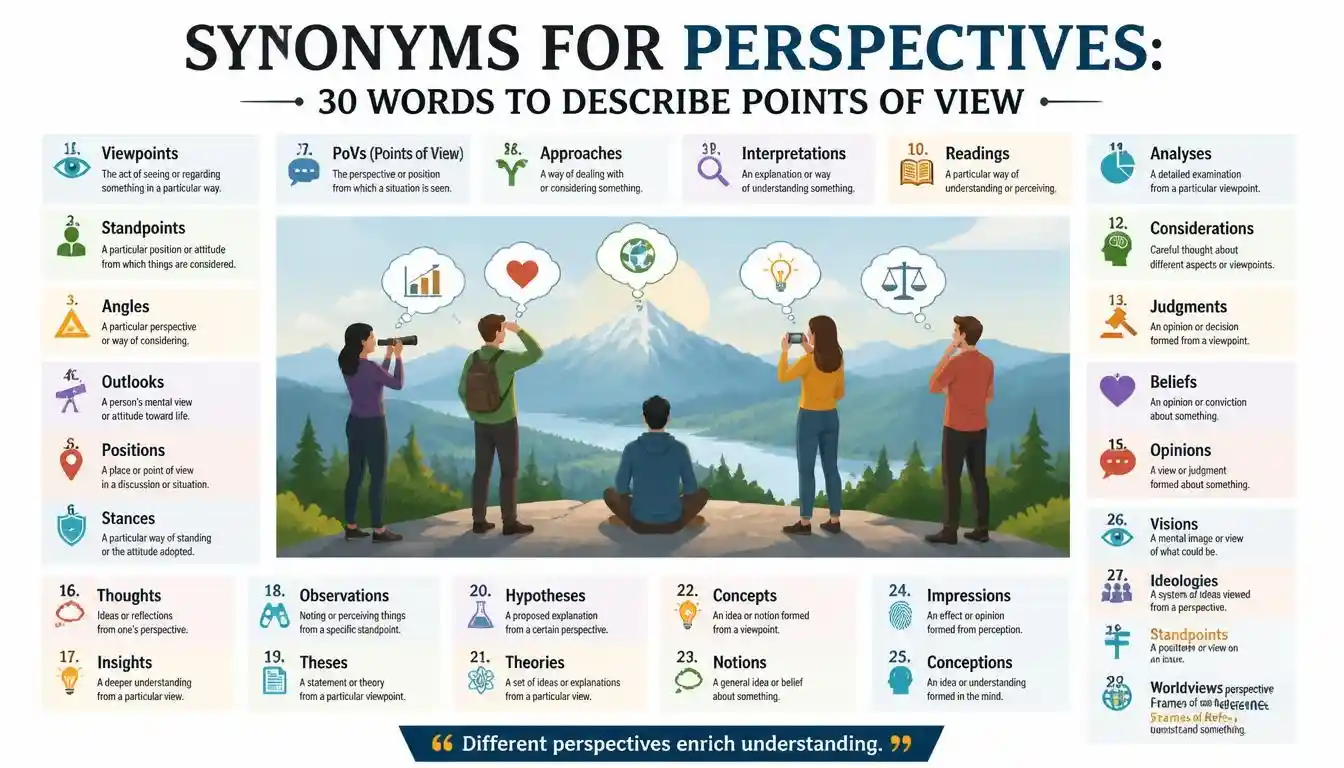
Synonyms for perspectives include viewpoints, opinions, outlooks, standpoints, angles, views, and stances. Perspectives are the ways people see or think about a topic. Each person looks at life in a different way. Learning these words helps you write and speak with more clarity.
Table: Synonyms of Perspectives
| Synonyms for Perspectives | Meaning |
| Attitudes | How a person feels about something |
| Beliefs | Ideas a person thinks are true |
| Takes | A short, personal view |
| Slants | A view that leans to one side |
| Positions | The side a person picks |
| Vantage points | Places from which to see clearly |
| Mindsets | Set ways of thinking |
| Interpretations | Ways of reading what something means |
Definition of Perspectives
- Definition: Perspectives are the ways a person sees or thinks about a topic.
- Example: Each child shared a different perspective on the story.
- Intensity and usage: It is a neutral word. It can mean a small idea or a deep life view. It does not say if a view is right or wrong.
- Usage note: It describes how people look at ideas, problems, or events. Short phrases: “fresh perspectives,” “different perspectives,” “global perspectives.”
Etymology of Perspectives
- Origin: It comes from the Latin word perspicere, which literally means “to look through.”
- Path to English: It passed through Medieval Latin perspectiva and then Old French perspective.
- Time period: It entered English in the late 1300s.
- Original sense today: The old idea of “seeing through” is only partly kept. Today it mostly means a way of seeing or thinking.
Word Formation of Perspectives
- Root word: specere is a Latin word that means “to look.”
- Prefix and suffix: per- means “through.” -ive forms a describing word. The last -s makes it plural.
- Literal sense: “Looking through” something to see it fully.
- Related English words: spectator, inspect, respect, suspect, aspect, and spectacle.
30 Synonyms for Perspectives
1. Viewpoints (Noun)
Meaning: Viewpoints are the places from which a person looks at a topic.
- Both viewpoints in the debate were clear.
- She heard many viewpoints before she chose.
2. Opinions (Noun)
Meaning: Opinions are the thoughts a person has about a topic.
- The class shared their opinions about the book.
- His opinions on food are strong.
3. Outlooks (Noun)
Meaning: Outlooks are the general ways people think about life.
- The friends have different outlooks on money.
- A bright outlook can help in hard times.
4. Standpoints (Noun)
Meaning: Standpoints are the points from which an issue is judged.
- From a health standpoint, the plan is good.
- The teachers shared their standpoints at the meeting.
5. Angles (Noun)
Meaning: Angles are the special ways of looking at a story or problem.
- The writer tried a new angle on the story.
- Let us look at the problem from all angles.
6. Views (Noun)
Meaning: Views are the ways a person sees a subject.
- Their views on school rules are different.
- He shared his views in a short talk.
7. Stances (Noun)
Meaning: Stances are the clear positions a person takes on an issue.
- The mayor took a firm stance on safety.
- Her stances on nature are well known.
8. Attitudes (Noun)
Meaning: Attitudes are the ways a person feels and thinks about something.
- Good attitudes make a team strong.
- Their attitudes toward change are open.
9. Beliefs (Noun)
Meaning: Beliefs are ideas a person holds as true that shape how they see things.
- Our beliefs shape how we see the world.
- He kept his beliefs when others disagreed.
10. Takes (Noun)
Meaning: Takes are short, personal views on a topic.
- I like her take on the new movie.
- The writers shared their takes on the game.
11. Slants (Noun)
Meaning: Slants are views that lean toward one side.
- The article had a slant toward the old plan.
- Any news story can carry a slant.
12. Positions (Noun)
Meaning: Positions are the sides a person picks on a matter.
- The leaders shared their positions on the new law.
- She changed her position after she learned the facts.
13. Vantage Points (Noun)
Meaning: Vantage points are places or ways of seeing that give a clear view of a matter.
- From his vantage point, the plan made sense.
- A teacher and a student have different vantage points.
14. Mindsets (Noun)
Meaning: Mindsets are set ways of thinking that shape how a person sees things.
- A growth mindset helps you learn new things.
- Their mindsets changed after the trip.
15. Interpretations (Noun)
Meaning: Interpretations are the ways a person understands what something means.
- Readers have many interpretations of the poem.
- Her interpretation of the facts was not like mine.
16. Points of View (Noun)
Meaning: Points of view are the ways a person sees a topic from their own place.
- The story is told from two points of view.
- Try to see the problem from their point of view.
17. Perceptions (Noun)
Meaning: Perceptions are the ways a person sees and understands something.
- Public perceptions of the shop have grown better.
- Our perceptions can change with new facts.
18. Sentiments (Noun)
Meaning: Sentiments are views that come from feelings.
- Many people shared the same sentiments about the news.
- His sentiments were clear in his letter.
19. Judgments (Noun)
Meaning: Judgments are views formed after careful thought.
- Do not rush your judgments about new people.
- The judges shared their final judgments.
20. Worldviews (Noun)
Meaning: Worldviews are the big ways a person sees life and the world.
- Travel can widen your worldviews.
- Their worldviews come from their culture.
21. Impressions (Noun)
Meaning: Impressions are the first views a person forms about something.
- Her first impressions of the city were warm.
- Our impressions of the plan were mixed.
22. Sides (Noun)
Meaning: Sides are the different views in a debate or story.
- Every story has two sides.
- The judge heard both sides of the case.
23. Approaches (Noun)
Meaning: Approaches are the ways a person chooses to look at a matter.
- The two teams took different approaches to the problem.
- Her calm approach helped everyone relax.
24. Frames of Reference (Noun)
Meaning: Frames of reference are the sets of ideas a person uses to see and judge things.
- Kids and adults have different frames of reference.
- Her frame of reference came from life in a small town.
25. Convictions (Noun)
Meaning: Convictions are strong views a person holds firmly.
- Her convictions about fairness never changed.
- They spoke with deep convictions.
26. Thoughts (Noun)
Meaning: Thoughts are the views a person has formed about a topic.
- We would love to hear your thoughts on the plan.
- His thoughts on the matter were short and clear.
27. Notions (Noun)
Meaning: Notions are general ideas or views a person has about something.
- She had old notions about how schools should work.
- Travel changed his notions about other places.
28. Understandings (Noun)
Meaning: Understandings are the ways a person makes sense of a topic.
- Our understanding of the story was not the same.
- Talking with others can deepen your understanding.
29. Lenses (Noun)
Meaning: Lenses are ways of seeing that color how a person views things.
- We read history through many lenses.
- The film looks at life through a child’s lens.
30. Ideas (Noun)
Meaning: Ideas are the views a person holds or shares about a matter.
- The students shared their ideas about the school trip.
- His ideas about work changed over time.
Antonyms of Perspectives
- Facts (Noun): Things known to be true that do not depend on one view.
- Tunnel vision (Noun): Seeing only one small part of a matter.
- Narrow-mindedness (Noun): Not wanting to think about ideas that differ from your own.
- Ignorance (Noun): Not knowing about other views.
- Unawareness (Noun): Not being aware that other views exist.
Conclusion
Learning synonyms and antonyms makes your writing richer and your speech clearer. Instead of using the same word again and again, you can pick the best word for each moment. This helps in blogs, emails, essays, articles, and daily talks. Try using two or three new words from this list each day. Practice them in short messages, school work, and chats with friends. Soon, these words will feel natural to you.

Welcome to Synotwin, your go-to digital platform for the latest breaking news, trending updates, technology insights, and informative articles. We are dedicated to providing accurate, engaging, and well-researched content designed to keep you informed in a fast-paced world.
At Synotwin, we believe that staying updated shouldn’t be complicated. Whether you are looking for current events, digital trends, practical tips, or in-depth analysis, our platform simplifies complex topics into clear, reader-friendly content.
Our Mission Our mission is simple: to deliver reliable and high-quality information that empowers our readers. We strive to maintain absolute transparency, editorial integrity, and continuous updates so that you always get the ground reality first.
What We Cover
-
Breaking News & Top Stories: Real-time updates on global and local trends.
-
Tech & Digital Insights: Practical guides, digital tools, and future innovations.
-
Lifestyle & Ideas: Informative content aimed at solving everyday queries.
Why Choose Synotwin?
-
Accurate & Fact-Checked: We carefully structure and verify our updates before sharing.
-
Reader-Centric Design: Clean layout tailored for smooth reading on mobile and desktop.
-
Always Updated: Fresh content published regularly to match real-time trends.
Thank you for visiting Synotwin. Explore our latest articles, stay informed, and feel free to connect with us through our contact page!