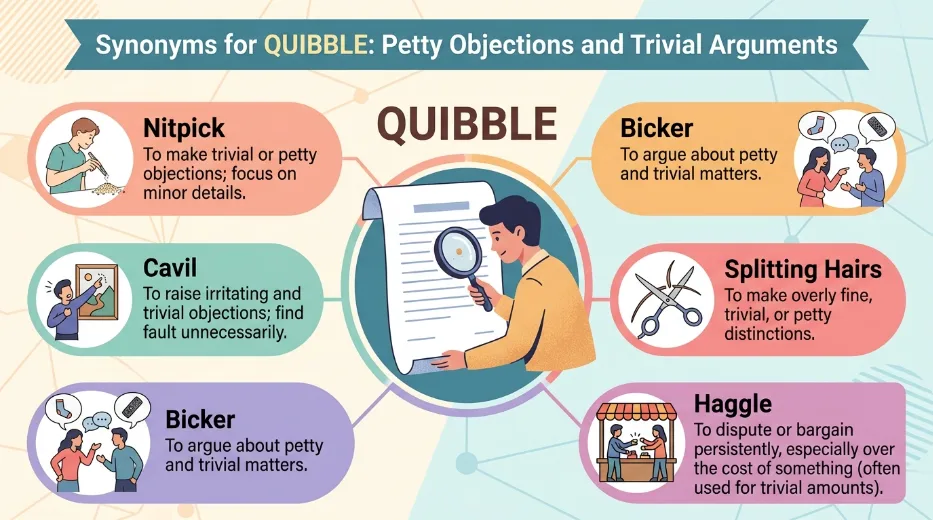
Synonyms for quibble include niggle, gripe, complaint, objection, cavil, nitpick, and grievance. Quibble means a small, often needless complaint about a minor point. People use it to describe petty objections that don’t affect the bigger picture. Writers reach for this word when a disagreement feels trivial rather than serious. This list gives you 30 clear options to choose from.
Table: Synonyms of Quibble
| Synonym | Meaning |
| Squabble | A minor, often petty argument |
| Protest | A statement of objection or disagreement |
| Criticism | Comments pointing out faults or issues |
| Grumble | A low, complaining remark |
| Dispute | A disagreement over a small point |
| Reservation | A slight doubt or objection |
| Grouse | An informal complaint about something minor |
| Fuss | Unnecessary excitement or complaint over a small matter |
Definition of Quibble
- A small, often unimportant complaint or objection about a minor detail.
- Example: She raised a quibble about the wording, though the plan itself was solid.
- It sits low on the complaint scale, smaller than an argument, bigger than silence.
- It describes minor objections and petty arguments. Common phrases: “a small quibble” and “a needless quibble.”
Etymology of Quibble
- The word’s exact origin stays uncertain among language historians.
- Some trace it to the old English term “quib,” meaning a clever or snide remark.
- English speakers began using it around the early 17th century.
- The original sense, a trivial objection, remains largely unchanged today.
Word Formation of Quibble
- The root likely ties back to “quib,” an old term for a sharp or witty remark.
- The ending “-ble” follows a common pattern seen in informal English words.
- Together, the word suggests a small, clever objection rather than a serious complaint.
- Related English words include “quibbler” and “quibbling.”
30 Synonyms for Quibble
1. Niggle (Noun)
Meaning: A small, nagging complaint or worry about a minor detail.
- His only niggle with the plan was the tight schedule.
- She couldn’t shake a small niggle about the contract terms.
2. Gripe (Noun)
Meaning: A minor, often informal complaint about something small.
- His biggest gripe was the slow internet connection.
- She voiced a quick gripe before moving on with her day.
3. Complaint (Noun)
Meaning: A statement expressing dissatisfaction over a minor issue.
- Her only complaint was the noise from the street outside.
- He filed a small complaint about the delayed delivery.
4. Objection (Noun)
Meaning: A reason given for disagreeing with a small point.
- He raised an objection to the meeting’s start time.
- Her objection was minor, so the plan moved forward anyway.
5. Cavil (Noun)
Meaning: A petty or trivial objection raised without strong cause.
- His cavil about the font size held up the whole design review.
- She dismissed the cavil and approved the report as written.
6. Nitpick (Noun)
Meaning: A minor criticism about a small, often unimportant detail.
- His only nitpick was the spacing between paragraphs.
- She offered one small nitpick before praising the rest of the essay.
7. Grievance (Noun)
Meaning: A minor complaint, often held onto for some time.
- His grievance about parking spots came up at every meeting.
- She finally voiced a grievance that had bothered her for weeks.
8. Squabble (Noun)
Meaning: A small, often petty argument over a minor issue.
- Their squabble over seating arrangements ended within minutes.
- A short squabble broke out about who would drive.
9. Protest (Noun)
Meaning: A statement showing disagreement, often over something small.
- She raised a mild protest about the new schedule.
- His protest was brief, and the plan stayed the same.
10. Criticism (Noun)
Meaning: A comment pointing out a small fault or issue.
- His only criticism was the slightly slow pacing of the film.
- She offered gentle criticism about the report’s formatting.
11. Grumble (Noun)
Meaning: A low, muttered complaint about something minor.
- A quiet grumble passed through the room about the long wait.
- His grumble about the weather didn’t stop the picnic plans.
12. Dispute (Noun)
Meaning: A small disagreement over a minor point or detail.
- Their dispute over the invoice was settled within a day.
- A brief dispute arose about which route to take.
13. Murmur (Noun)
Meaning: A quiet, indirect complaint, often shared among a group.
- A murmur of complaint spread through the audience about the delay.
- She heard a soft murmur of disagreement from the back row.
14. Reservation (Noun)
Meaning: A slight doubt or objection about part of a plan.
- He had one small reservation about the new policy.
- Her only reservation was the tight deadline attached to the project.
15. Dissent (Noun)
Meaning: A difference of opinion, often minor, from the majority view.
- A quiet dissent came from one member of the committee.
- His dissent focused only on a small part of the proposal.
16. Protestation (Noun)
Meaning: A formal or mild expression of objection.
- Her protestation was brief and didn’t change the final decision.
- He offered a light protest before agreeing to the terms.
17. Exception (Noun)
Meaning: A point of disagreement raised against part of a statement.
- She took exception to one small line in the report.
- His exception was minor, so the document stayed unchanged.
18. Beef (Noun)
Meaning: An informal, minor complaint about something specific.
- His only beef with the app was the slow loading time.
- She had a small beef about the meeting running late.
19. Grouse (Noun)
Meaning: An informal complaint about a small, everyday annoyance.
- His grouse about the coffee machine came up almost daily.
- She let out a quick grouse before getting back to work.
20. Fuss (Noun)
Meaning: Unnecessary excitement or complaint over a minor matter.
- He made a small fuss about the seating chart.
- There was no need for such a fuss over a minor delay.
21. Bickering (Noun)
Meaning: Small, repeated arguing over minor or trivial points.
- Their bickering over the remote control never lasted long.
- A little bickering broke out about whose turn it was.
22. Hairsplitting (Noun)
Meaning: Making overly fine distinctions about a minor point.
- His hairsplitting over word choice slowed down the edit.
- She avoided hairsplitting and focused on the bigger picture instead.
23. Pettifoggery (Noun)
Meaning: Excessive attention to unimportant details, often in argument.
- His pettifoggery over minor clauses annoyed the whole legal team.
- She had little patience for pettifoggery during busy weeks.
24. Demur (Noun)
Meaning: A mild show of reluctance or objection.
- He offered a small demur before signing the agreement.
- Her demur was quiet, but everyone noticed it.
25. Faultfinding (Noun)
Meaning: A habit of pointing out small flaws or issues.
- His constant faultfinding wore down the rest of the team.
- She tried to reduce her faultfinding and focus on solutions instead.
26. Carping (Noun)
Meaning: Persistent, often unnecessary complaining about small matters.
- His carping about minor delays annoyed his coworkers.
- She grew tired of the constant carping during meetings.
27. Quarrel (Noun)
Meaning: A small disagreement or argument over a minor issue.
- Their quarrel over the bill ended almost as fast as it began.
- A short quarrel broke out about which movie to watch.
28. Misgiving (Noun)
Meaning: A slight feeling of doubt about part of a plan.
- She had one small misgiving about the new schedule.
- His only misgiving involved the shorter timeline.
29. Fault (Noun)
Meaning: A small flaw or issue used as grounds for complaint.
- He found one small fault in an otherwise strong proposal.
- She pointed out a minor fault in the design layout.
30. Peeve (Noun)
Meaning: A minor annoyance that leads to a small complaint.
- Slow walkers were his biggest pet peeve at the airport.
- Her peeve about loud chewing came up often at lunch.
Antonyms of Quibble
- Agreement (Noun): a shared opinion reached without complaint.
- Approval (Noun): acceptance or a positive judgment of something.
- Praise (Noun): words that express admiration rather than complaint.
- Acceptance (Noun): a willingness to accept something without objection.
- Harmony (Noun): a state of peaceful, complaint-free agreement.
Conclusion
Learning synonyms and antonyms sharpens how you write and speak. A wider word choice makes blog posts, essays, and emails feel more precise and less repetitive. It also helps conversations sound more natural and less flat. Try swapping in a few of these words during your next email, article, or discussion. Small shifts in word choice often make writing feel far more alive and clear.

Welcome to Synotwin, your go-to digital platform for the latest breaking news, trending updates, technology insights, and informative articles. We are dedicated to providing accurate, engaging, and well-researched content designed to keep you informed in a fast-paced world.
At Synotwin, we believe that staying updated shouldn’t be complicated. Whether you are looking for current events, digital trends, practical tips, or in-depth analysis, our platform simplifies complex topics into clear, reader-friendly content.
Our Mission Our mission is simple: to deliver reliable and high-quality information that empowers our readers. We strive to maintain absolute transparency, editorial integrity, and continuous updates so that you always get the ground reality first.
What We Cover
-
Breaking News & Top Stories: Real-time updates on global and local trends.
-
Tech & Digital Insights: Practical guides, digital tools, and future innovations.
-
Lifestyle & Ideas: Informative content aimed at solving everyday queries.
Why Choose Synotwin?
-
Accurate & Fact-Checked: We carefully structure and verify our updates before sharing.
-
Reader-Centric Design: Clean layout tailored for smooth reading on mobile and desktop.
-
Always Updated: Fresh content published regularly to match real-time trends.
Thank you for visiting Synotwin. Explore our latest articles, stay informed, and feel free to connect with us through our contact page!