
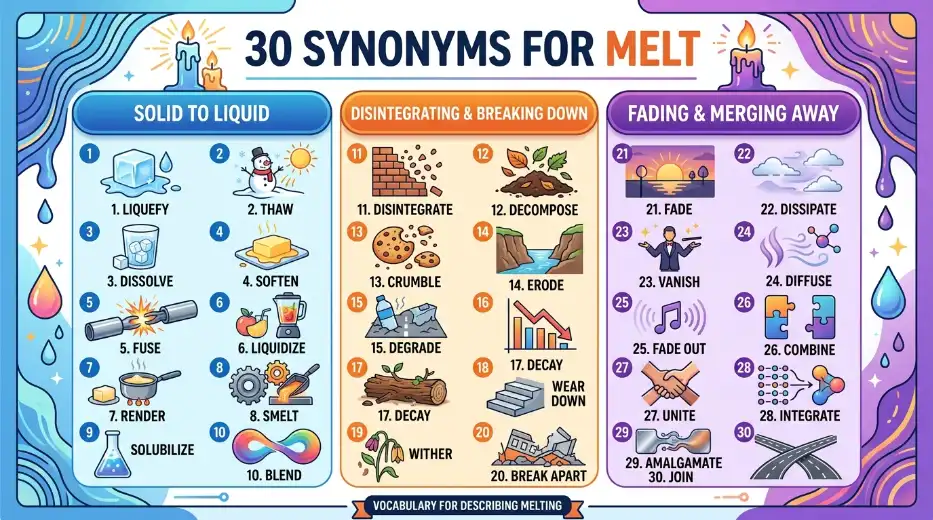
Synonyms for melt include liquefy, thaw, dissolve, soften, defrost, fuse, and smelt. Melt means to change from a solid into a liquid, usually because of heat. These words are useful when you want to describe ice, snow, butter, metal, or even emotions turning soft. Each one carries a slightly different shade of meaning, from gentle warming to complete liquid change.
Table: Synonyms of Melt
| Synonym | Meaning |
| Unfreeze | To thaw something frozen |
| Render | To melt fat slowly |
| Run | To become liquid and flow |
| Blend | To mix smoothly together |
| Merge | To combine into one form |
| Dissipate | To slowly disappear |
| Vanish | To disappear completely |
| Fade | To lessen and disappear |
Definition of Melt
- Means to change from a solid to a liquid, usually by heating it.
- Example: The ice cream began to melt in the hot sun.
- Sits at the high end of the “change of state” scale, showing a full shift from solid to liquid.
- Usage note: Often describes ice, snow, butter, chocolate, or metal. Common phrases: “melt in your mouth,” “melt away,” “melt down.”
Etymology of Melt
- It comes from the Old English word meltan, meaning “to become liquid.”
- Related to the Old Norse word melta, used for digesting or softening food.
- Entered English before the 12th century, during the Old English period.
- The original sense of “turning from solid to liquid” is still the main meaning used today.
Word Formation of Melt
- Root word: meltan (Old English), meaning “to become soft or liquid.”
- No major prefix or suffix is attached; “melt” is a simple base verb.
- The literal sense is “to turn soft and flow,” which matches its modern use.
- Related English words sharing the root include “smelt,” “melted,” “melting,” and “meltdown.”
30 Synonyms for Melt
1. Liquefy (Verb)
Meaning: To turn from a solid into a liquid.
- The heat caused the wax to liquefy quickly.
- Scientists liquefy gases to store them in smaller tanks.
2. Thaw (Verb)
Meaning: To melt after being frozen.
- The frozen chicken will thaw overnight in the fridge.
- Spring sunshine helped the icy pond thaw.
3. Dissolve (Verb)
Meaning: To break down and blend into a liquid.
- Sugar will dissolve fast in warm water.
- The tablet dissolved completely within minutes.
4. Soften (Verb)
Meaning: To become less solid or hard.
- The butter will soften if you leave it out.
- Warm oil helps soften stiff leather.
5. Defrost (Verb)
Meaning: To remove frost or ice by warming.
- She let the frozen peas defrost on the counter.
- We defrost the freezer once a month.
6. Deliquesce (Verb)
Meaning: To gradually melt by absorbing moisture.
- Certain salts deliquesce when left in damp air.
- The crystals began to deliquesce overnight.
7. Fuse (Verb)
Meaning: To melt and join together as one.
- The two metals fuse under extreme heat.
- Glassmakers fuse colored shards to form patterns.
8. Smelt (Verb)
Meaning: To melt ore to extract metal.
- Workers smelt iron ore in massive furnaces.
- Ancient cultures learned to smelt copper long ago.
9. Unfreeze (Verb)
Meaning: To thaw something that was frozen solid.
- Please unfreeze the shrimp before cooking.
- The warm room helped unfreeze the pipes.
10. Render (Verb)
Meaning: To melt fat slowly using low heat.
- Grandma would render lard for baking pies.
- Chefs render duck fat to use in roasting.
11. Run (Verb)
Meaning: To become liquid and flow freely.
- The candle wax began to run down the sides.
- Watercolor paint can run if the paper gets too wet.
12. Blend (Verb)
Meaning: To mix smoothly as a substance softens.
- The colors blend as the crayon melts on the paper.
- Warm cheese will blend nicely into the sauce.
13. Merge (Verb)
Meaning: To combine into a single liquid form.
- The two streams of molten metal merge in the mold.
- Melted chocolate and cream merge into a smooth glaze.
14. Dissipate (Verb)
Meaning: To gradually disappear as heat spreads it.
- The frost began to dissipate as the sun rose.
- Morning fog dissipates once temperatures climb.
15. Vanish (Verb)
Meaning: To disappear completely, often like melting away.
- The snowman seemed to vanish overnight.
- Ice cubes vanish quickly in warm drinks.
16. Fade (Verb)
Meaning: To slowly weaken and disappear.
- The frost patterns fade as the window warms.
- Winter’s chill will fade once spring arrives.
17. Thin (Verb)
Meaning: To become less solid or thick.
- The sauce will thin as it heats up.
- Ice thins near the edges of the lake first.
18. Loosen (Verb)
Meaning: To become less firm or rigid.
- Heat helps loosen hardened glue.
- The frozen lock began to loosen in the sun.
19. Relax (Verb)
Meaning: To soften or ease from a stiff state.
- Warm water helps relax tense, cold muscles.
- The wax started to relax under the lamp’s heat.
20. Mellow (Verb)
Meaning: To soften gradually over time or heat.
- Slow cooking helps the flavors mellow together.
- The hard caramel will mellow once warmed.
21. Temper (Verb)
Meaning: To soften or adjust through controlled heating.
- Bakers temper chocolate to keep it glossy.
- Metalworkers temper steel to change its hardness.
22. Liquidize (Verb)
Meaning: To turn something solid into liquid form.
- The blender can liquidize frozen fruit quickly.
- Heat will liquidize the block of cheese.
23. Slacken (Verb)
Meaning: To become looser or less firm.
- The frozen rope began to slacken in the sun.
- Cold butter will slacken once it warms up.
24. Yield (Verb)
Meaning: To give way and soften under heat or pressure.
- The ice began to yield along the riverbank.
- Old wax will yield easily near a flame.
25. Disperse (Verb)
Meaning: To spread out and disappear as it warms.
- The morning frost will disperse by noon.
- Heat causes the icy mist to disperse.
26. Diminish (Verb)
Meaning: To shrink gradually, similar to melting away.
- The snowdrifts diminish with each sunny day.
- The ice sculpture began to diminish in the heat.
27. Warm (Verb)
Meaning: To heat something until it begins to soften.
- Warm the chocolate slowly so it doesn’t burn.
- She warmed the butter before spreading it.
28. Relent (Verb)
Meaning: To soften or ease off, often used figuratively.
- The icy weather finally began to relent.
- His stern mood seemed to relent by evening.
29. Unbend (Verb)
Meaning: To soften or become less rigid.
- The stiff frost began to unbend as the day warmed.
- Cold clay will unbend once it’s handled.
30. Dwindle (Verb)
Meaning: To gradually shrink away, much like melting ice.
- The pile of snow began to dwindle by afternoon.
- The glacier continues to dwindle each summer.
Antonyms of Melt
- Freeze (Verb): To turn a liquid into a solid using cold.
- Solidify (Verb): To become firm or solid.
- Harden (Verb): To grow stiff and firm.
- Congeal (Verb): To thicken and turn solid, often when cooling.
- Set (Verb): To become fixed and firm after cooling.
Conclusion
Learning synonyms and antonyms like these makes your writing clearer and more interesting. Instead of repeating the word “melt,” you can choose from “thaw,” “dissolve,” or “liquefy” to match your tone. This skill helps in blogging, emails, essays, and everyday conversation. Strong word choices keep readers engaged and show real command of language.
Try using a few new synonyms the next time you write or speak, and watch your communication grow sharper and more natural.

Welcome to Synotwin, your go-to digital platform for the latest breaking news, trending updates, technology insights, and informative articles. We are dedicated to providing accurate, engaging, and well-researched content designed to keep you informed in a fast-paced world.
At Synotwin, we believe that staying updated shouldn’t be complicated. Whether you are looking for current events, digital trends, practical tips, or in-depth analysis, our platform simplifies complex topics into clear, reader-friendly content.
Our Mission Our mission is simple: to deliver reliable and high-quality information that empowers our readers. We strive to maintain absolute transparency, editorial integrity, and continuous updates so that you always get the ground reality first.
What We Cover
-
Breaking News & Top Stories: Real-time updates on global and local trends.
-
Tech & Digital Insights: Practical guides, digital tools, and future innovations.
-
Lifestyle & Ideas: Informative content aimed at solving everyday queries.
Why Choose Synotwin?
-
Accurate & Fact-Checked: We carefully structure and verify our updates before sharing.
-
Reader-Centric Design: Clean layout tailored for smooth reading on mobile and desktop.
-
Always Updated: Fresh content published regularly to match real-time trends.
Thank you for visiting Synotwin. Explore our latest articles, stay informed, and feel free to connect with us through our contact page!