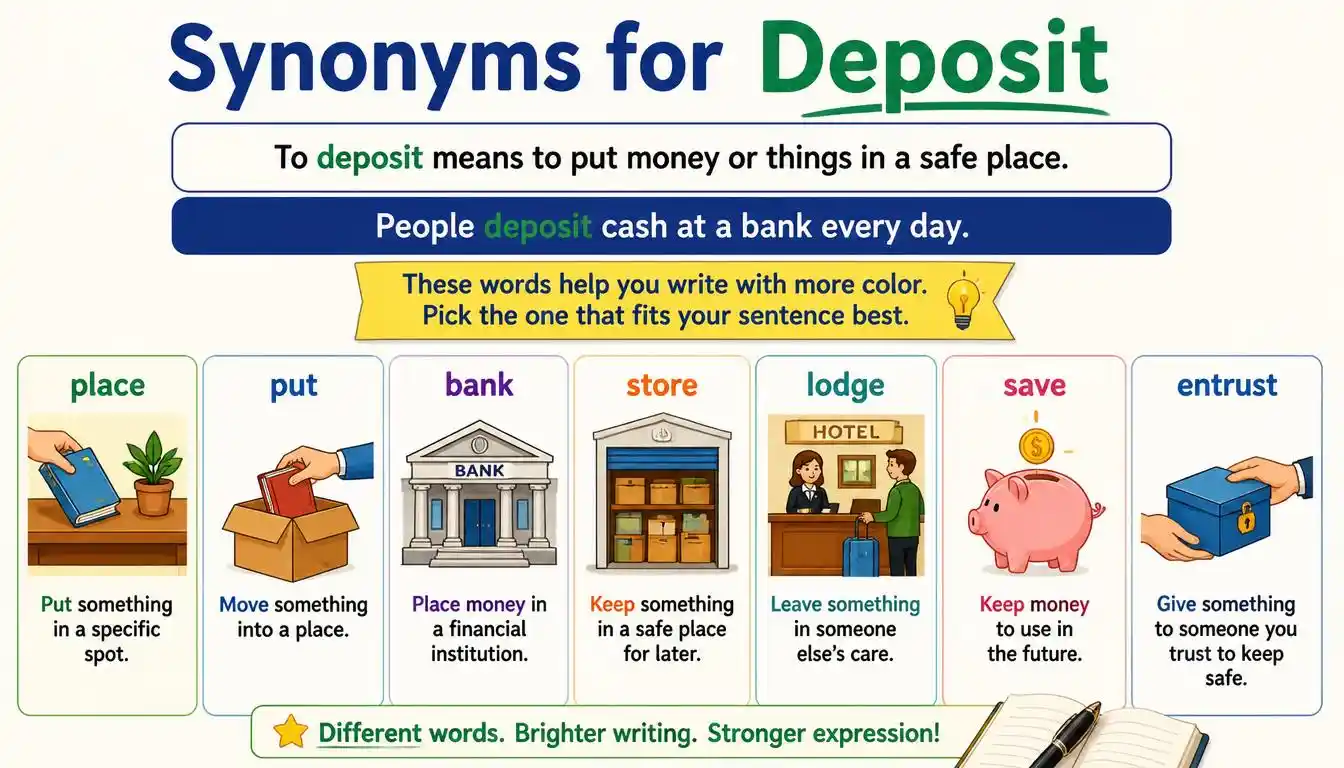
Synonyms for deposit include place, put, bank, store, lodge, save, and entrust. To deposit means to put money or things in a safe place. People deposit cash at a bank every day. These words help you write with more color. Pick the one that fits your sentence best.
Table: Synonyms of Deposit
| Synonym | Meaning |
| Set | Put in a spot |
| Park | Leave for a while |
| Lay | Put down |
| Position | Put in the right place |
| Stash | Hide away |
| Consign | Hand over for care |
| Stow | Put away |
| Drop | Leave at a place |
Definition of Deposit
- Definition: To put money or things in a place to keep them safe. As a noun, it is the money or thing that you put there.
- Example: “Mia will deposit her pay at the bank today.”
- Usage context: It is a neutral word. It fits small daily acts and big money moves.
- Usage note: It describes what we do with money, checks, or items. Phrases: “deposit cash,” “deposit a check,” “deposit your savings.”
Etymology of Deposit
- It comes from the Latin word depositum. The root verb is deponere. It means “to put down.”
- Some forms of the word also passed through French.
- It entered English in the early 1600s.
- The old sense is still alive today. To deposit still means to put something down to keep it safe.
Word Formation of Deposit
- The root is ponere. It means “to put” or “to place.”
- The prefix de- means “down” or “away.”
- Together they give the sense “to put down” or “to put away.”
- Other English words with the same root include position, compose, expose, impose, and propose.
30 Synonyms for Deposit
1. Place (Verb)
Meaning: To put money or things in a spot.
- She placed her savings in a safe box.
- Place the check in the bank slot.
2. Put (Verb)
Meaning: To set money or things in a spot to keep them safe.
- He put his cash in the bank before noon.
- Please put the ring in the safe.
3. Bank (Verb)
Meaning: To put money in a bank account.
- Mia banks part of her pay each week.
- We banked the money after the sale.
4. Store (Verb)
Meaning: To keep money or things in a place for later.
- They store old photos in a strong box.
- The shop stores extra cash in a safe.
5. Lodge (Verb)
Meaning: To leave money or things with a person or place to keep them safe.
- He lodged the papers with his lawyer.
- Lodge your bag at the front desk.
6. Save (Verb)
Meaning: To put money aside so you can keep it.
- Sam saves a little money each month.
- Save this cash for the trip.
7. Entrust (Verb)
Meaning: To give money or things to someone you trust to keep.
- She entrusted her savings to the bank.
- Dad entrusted the spare key to his neighbor.
8. Set (Verb)
Meaning: To put money or things down in a place.
- Set the cash in the top drawer.
- He set the box inside the vault.
9. Park (Verb)
Meaning: To leave money in a safe place for a short time.
- She parked her cash in a savings account.
- He parked his bonus in the bank until June.
10. Lay (Verb)
Meaning: To put money or things down in a place.
- Lay the coins on the counter.
- She laid the money in the small box.
11. Position (Verb)
Meaning: To put money or things in the right place.
- The guard positioned the cash box in the safe.
- Position the bag by the bank door.
12. Stash (Verb)
Meaning: To put money or things away in a hidden spot.
- He stashed his cash in a drawer.
- Kids often stash coins in jars.
13. Consign (Verb)
Meaning: To hand over money or things to a person or place for care.
- The family consigned the funds to a trust.
- He consigned his gold ring to the bank vault.
14. Stow (Verb)
Meaning: To put things away in a safe spot.
- He stowed the cash in a locked box.
- She stowed her ring in the safe.
15. Drop (Verb)
Meaning: To leave money or things at a place.
- Drop the check at the bank today.
- I will drop the cash at the front desk.
16. Leave (Verb)
Meaning: To let money or things stay in a place.
- Leave your cash in the safe tonight.
- She left her savings in the bank.
17. Commit (Verb)
Meaning: To put money into an account for a set use.
- He committed his savings to a fixed account.
- They committed funds to the school account.
18. Warehouse (Verb)
Meaning: To store goods in a large and safe place.
- The shop warehouses its goods in a big shed.
- They warehoused the boxes until spring.
19. Transfer (Verb)
Meaning: To move money into an account.
- She transferred her pay into savings.
- Transfer the cash to the new account.
20. Credit (Verb)
Meaning: To add money to an account.
- The bank credited my account with fifty dollars.
- They will credit the check by noon.
21. Keep (Verb)
Meaning: To hold money or things in a safe place.
- Keep your cash in the bank.
- He keeps his rings in a small box.
22. Cache (Verb)
Meaning: To store things in a hidden place for later.
- Hikers cached food in a tree.
- She cached some cash in a tin.
23. Hide (Verb)
Meaning: To put money or things out of sight to keep them safe.
- He hid his savings behind a book.
- Hide the spare key in a safe spot.
24. Secure (Verb)
Meaning: To put money or things in a safe place.
- She secured the cash in a locked box.
- Secure your savings in a good bank.
25. Safeguard (Verb)
Meaning: To place money or things where they stay safe.
- They safeguard their money in a bank.
- Safeguard your papers in a strong box.
26. Vault (Verb)
Meaning: To store money or things in a strong safe room.
- The bank vaults large sums each night.
- The museum vaulted the gems after closing.
27. Tuck (Verb)
Meaning: To put money or things away in a snug and safe spot.
- She tucked the cash into her bag.
- Tuck the coins into the small pouch.
28. House (Verb)
Meaning: To keep money or things inside a place.
- The bank houses the cash in a vault.
- A metal box houses his coins.
29. Reposit (Verb)
Meaning: To place money or things away to keep them safe. It is a formal word.
- The clerk reposited the funds in the safe.
- He reposited his gems with the bank.
30. Reserve (Verb)
Meaning: To set money aside for later use.
- She reserved part of her pay for rent.
- The club reserves cash for repairs.
Antonyms of Deposit
- Withdraw (Verb): To take money out of an account.
- Remove (Verb): To take something away from a place.
- Retrieve (Verb): To get back something you left.
- Reclaim (Verb): To ask for back what is yours.
- Collect (Verb): To pick up money or things left in a place.
Conclusion
Learning synonyms and antonyms makes your words stronger. Your writing, blogs, and speech sound fresh and clear. You also avoid using the same word again and again. Try these new words in emails, essays, articles, and daily talks. Pick one word each day and use it. Soon these words will feel easy and natural.

Welcome to Synotwin, your go-to digital platform for the latest breaking news, trending updates, technology insights, and informative articles. We are dedicated to providing accurate, engaging, and well-researched content designed to keep you informed in a fast-paced world.
At Synotwin, we believe that staying updated shouldn’t be complicated. Whether you are looking for current events, digital trends, practical tips, or in-depth analysis, our platform simplifies complex topics into clear, reader-friendly content.
Our Mission Our mission is simple: to deliver reliable and high-quality information that empowers our readers. We strive to maintain absolute transparency, editorial integrity, and continuous updates so that you always get the ground reality first.
What We Cover
-
Breaking News & Top Stories: Real-time updates on global and local trends.
-
Tech & Digital Insights: Practical guides, digital tools, and future innovations.
-
Lifestyle & Ideas: Informative content aimed at solving everyday queries.
Why Choose Synotwin?
-
Accurate & Fact-Checked: We carefully structure and verify our updates before sharing.
-
Reader-Centric Design: Clean layout tailored for smooth reading on mobile and desktop.
-
Always Updated: Fresh content published regularly to match real-time trends.
Thank you for visiting Synotwin. Explore our latest articles, stay informed, and feel free to connect with us through our contact page!