
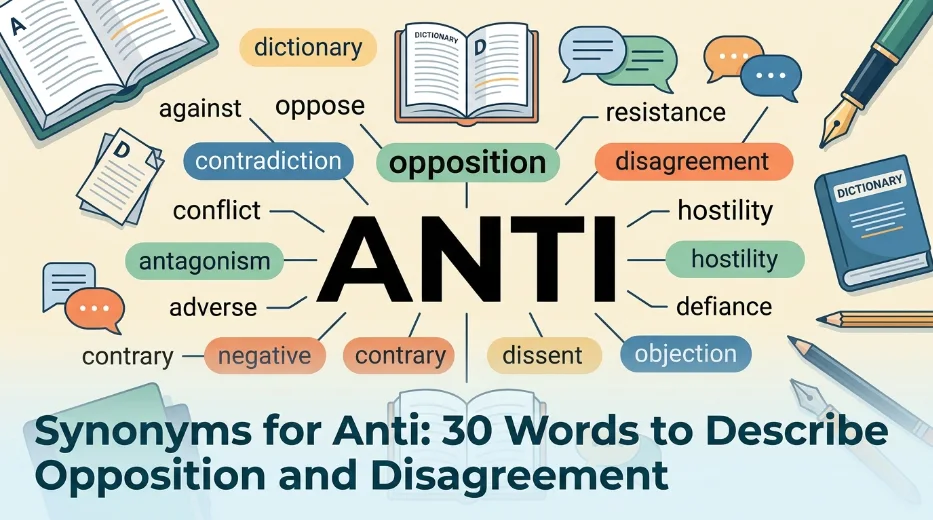
Synonyms for anti include opposed, against, hostile, contrary, opposing, resistant, and adverse. The word anti describes a position of being against, opposed to, or in disagreement with something. It is commonly used to express opposition toward ideas, actions, groups, beliefs, or movements. Understanding synonyms for anti helps writers choose more precise words for different levels of disagreement or resistance.
Table: Synonyms of Anti
| Synonym | Meaning |
| Against | In opposition to something |
| Contradictory | Showing disagreement or conflict |
| Resistant | Opposing or refusing to accept |
| Negative | Showing rejection or disapproval |
| Unfriendly | Lacking support or goodwill |
| Adverse | Harmful or unfavorable |
| Conflicting | Not agreeing with another view |
| Dissenting | Expressing disagreement |
Definition of Anti
- Definition: Showing opposition, disagreement, or dislike toward something.
- Example: The group organized an anti-war campaign to promote peace.
- Intensity/Usage Context: Anti can range from mild disagreement to strong opposition depending on the situation.
- Usage Note: It usually modifies ideas, actions, movements, or attitudes:
- anti-government views
- anti-smoking campaign
- anti-social behavior
Etymology of Anti
- Origin language: Greek prefix anti-, meaning “against” or “opposite.”
- The prefix passed through Latin before entering English.
- It became common in English during the 16th century through scientific, political, and social terminology.
- The original sense of opposition is still retained today.
Word Formation of Anti
- Root word: anti- meaning “against” or “opposite.”
- Prefix: anti- itself acts as a prefix showing opposition or prevention.
- Literal sense: Something positioned against another thing.
- Words sharing the same root:
- antibody
- antibiotic
- antifreeze
- antisocial
30 Synonyms for Anti
1. Opposed (Adjective)
Meaning: Showing disagreement or resistance toward something.
- Many residents were opposed to the new construction plan.
- She remained opposed to unfair treatment.
2. Against (Preposition/Adjective)
Meaning: Showing a position that disagrees with something.
- They voted against the proposed changes.
- He is against unnecessary rules.
3. Hostile (Adjective)
Meaning: Showing strong opposition or unfriendliness.
- The speaker faced a hostile audience during the debate.
- His hostile attitude created tension.
4. Opposing (Adjective)
Meaning: Acting in disagreement with something.
- The opposing team challenged every decision.
- She shared an opposing opinion during the meeting.
5. Contrary (Adjective)
Meaning: Opposite or against an idea.
- His actions were contrary to company policies.
- The results were contrary to expectations.
6. Resistant (Adjective)
Meaning: Refusing to accept or support something.
- The community was resistant to the proposed changes.
- Some people are resistant to new technology.
7. Adverse (Adjective)
Meaning: Negative or unfavorable toward something.
- The medicine caused adverse reactions.
- Weather conditions had an adverse effect on travel.
8. Negative (Adjective)
Meaning: Showing rejection or lack of support.
- She gave negative feedback about the proposal.
- His negative response surprised everyone.
9. Unfriendly (Adjective)
Meaning: Not supportive or welcoming.
- The organization received an unfriendly response.
- His unfriendly comments damaged relationships.
10. Conflicting (Adjective)
Meaning: Showing disagreement between ideas or views.
- The report included conflicting opinions.
- They had conflicting goals.
11. Dissenting (Adjective)
Meaning: Expressing disagreement with an accepted view.
- The judge wrote a dissenting opinion.
- A dissenting voice questioned the decision.
12. Disagreeing (Adjective)
Meaning: Having a different or opposite opinion.
- The disagreeing members requested more discussion.
- She was disagreeing with the final decision.
13. Critical (Adjective)
Meaning: Expressing disapproval or opposition.
- The article was critical of government policies.
- He gave a critical review of the plan.
14. Negative-minded (Adjective)
Meaning: Having a tendency to oppose or reject ideas.
- His negative-minded approach limited creativity.
- A negative-minded attitude can slow progress.
15. Resistant (Adjective)
Meaning: Opposing change or influence.
- The workers were resistant to the new system.
- She remained resistant to outside pressure.
16. Unfavorable (Adjective)
Meaning: Not supporting or approving something.
- The decision received unfavorable reactions.
- The review contained unfavorable comments.
17. Disapproving (Adjective)
Meaning: Showing a lack of approval.
- Her disapproving look revealed her feelings.
- The manager gave a disapproving response.
18. Rejecting (Adjective)
Meaning: Refusing to accept or support something.
- The committee took a rejecting stance.
- His rejecting attitude stopped cooperation.
19. Opposite (Adjective)
Meaning: Completely different or against something.
- Their opinions were opposite to each other.
- The results showed the opposite effect.
20. Counter (Adjective)
Meaning: Acting against or opposing something.
- They created a counter argument during the discussion.
- The team developed a counter strategy.
21. Rebellious (Adjective)
Meaning: Resisting authority or accepted ideas.
- The rebellious group challenged traditional rules.
- His rebellious nature encouraged change.
22. Defiant (Adjective)
Meaning: Showing resistance or refusal to obey.
- The activist remained defiant despite criticism.
- Her defiant statement attracted attention.
23. Antagonistic (Adjective)
Meaning: Actively opposing or causing conflict.
- His antagonistic behavior affected teamwork.
- The debate became antagonistic quickly.
24. Incompatible (Adjective)
Meaning: Unable to exist together due to differences.
- Their beliefs were incompatible with each other.
- The two systems were incompatible.
25. Unsupportive (Adjective)
Meaning: Not providing agreement or encouragement.
- The committee was unsupportive of the proposal.
- His unsupportive comments lowered morale.
26. Resistant (Adjective)
Meaning: Unwilling to accept or follow something.
- The company was resistant to new regulations.
- Some people remain resistant to change.
27. Disputing (Adjective)
Meaning: Challenging or arguing against something.
- The lawyer presented a disputing argument.
- They were disputing the accuracy of the report.
28. Conflicting (Adjective)
Meaning: Opposing another position or idea.
- The teams had conflicting strategies.
- Conflicting opinions delayed the decision.
29. Oppositional (Adjective)
Meaning: Characterized by resistance or disagreement.
- His oppositional behavior caused problems.
- The group adopted an oppositional stance.
30. Anti-supportive (Adjective)
Meaning: Acting against support or approval.
- The campaign promoted an anti-supportive message.
- His anti-supportive remarks affected cooperation.
Antonyms of Anti
- Supportive (Adjective): Showing approval or encouragement.
- Favorable (Adjective): Showing approval or positive feelings.
- Agreeable (Adjective): Willing to accept or support.
- Friendly (Adjective): Showing kindness and cooperation.
- Pro (Adjective): Supporting a particular idea or action.
Conclusion
Learning synonyms and antonyms improves writing by helping you express ideas with accuracy and variety. Instead of repeating simple words, writers can choose terms that match the exact level of agreement or opposition. Building vocabulary helps create stronger blogs, essays, emails, and conversations. Regular practice with synonyms and antonyms makes communication clearer, more professional, and more engaging.

Welcome to Synotwin, your go-to digital platform for the latest breaking news, trending updates, technology insights, and informative articles. We are dedicated to providing accurate, engaging, and well-researched content designed to keep you informed in a fast-paced world.
At Synotwin, we believe that staying updated shouldn’t be complicated. Whether you are looking for current events, digital trends, practical tips, or in-depth analysis, our platform simplifies complex topics into clear, reader-friendly content.
Our Mission Our mission is simple: to deliver reliable and high-quality information that empowers our readers. We strive to maintain absolute transparency, editorial integrity, and continuous updates so that you always get the ground reality first.
What We Cover
-
Breaking News & Top Stories: Real-time updates on global and local trends.
-
Tech & Digital Insights: Practical guides, digital tools, and future innovations.
-
Lifestyle & Ideas: Informative content aimed at solving everyday queries.
Why Choose Synotwin?
-
Accurate & Fact-Checked: We carefully structure and verify our updates before sharing.
-
Reader-Centric Design: Clean layout tailored for smooth reading on mobile and desktop.
-
Always Updated: Fresh content published regularly to match real-time trends.
Thank you for visiting Synotwin. Explore our latest articles, stay informed, and feel free to connect with us through our contact page!