
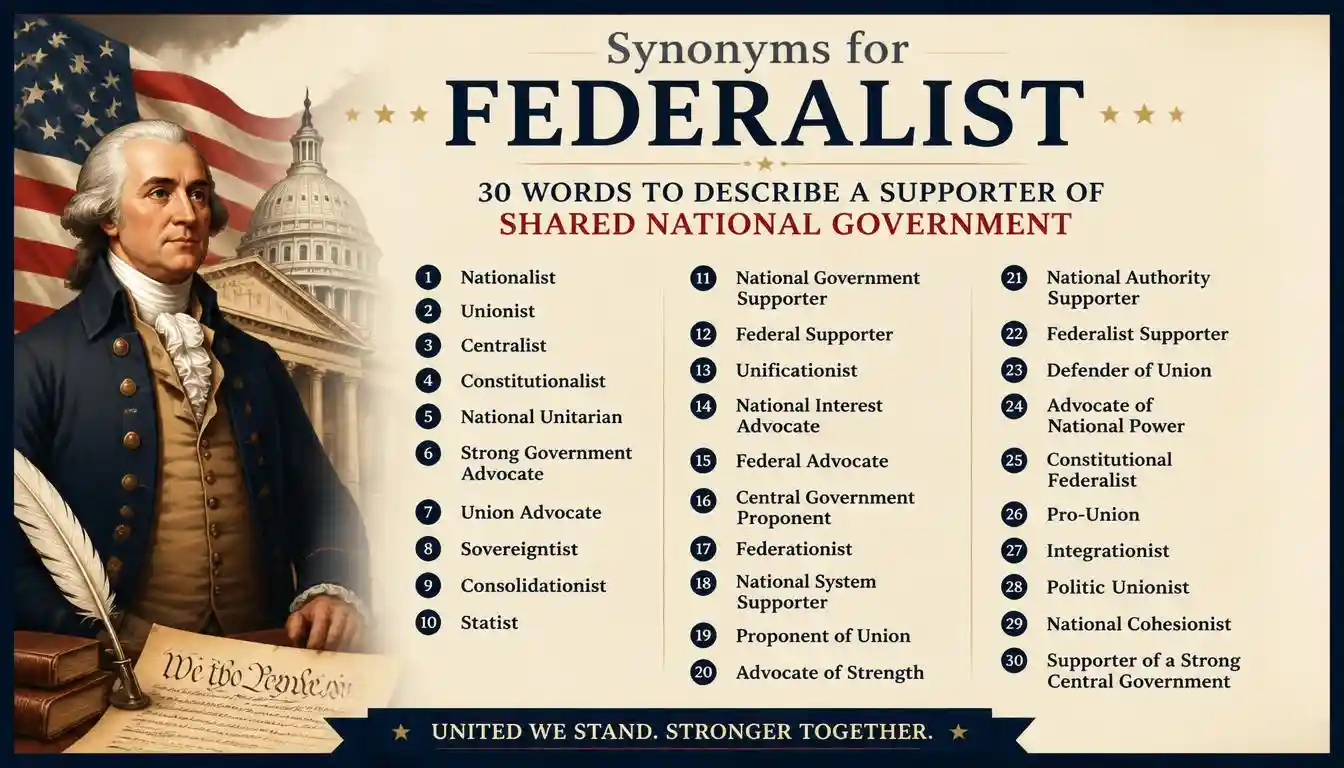
Synonyms for federalist include centralist, unionist, nationalist, constitutionalist, Hamiltonian, federationist, and unifier. A federalist is a person who backs a government where power is shared between a national government and the states. In early American history the word also meant a person who supported the new Constitution. This list gives you clear words for every kind of writing.
Table: Synonyms of Federalist
| Word | Meaning |
| Supporter | A person who backs an idea |
| Advocate | A person who speaks up for a cause |
| Proponent | A person who argues in favor of a plan |
| Partisan | A strong follower of one side |
| Loyalist | A person who stays faithful to a group |
| Integrationist | A person who wants parts joined as one |
| Ratifier | A person who votes to approve a plan |
| Federal | Related to a central government that shares power |
Definition of Federalist
- A federalist is a person who supports a strong national government that shares power with the states.
- Example: The federalist told the crowd why one strong nation is safer.
- Intensity: The word is mild to strong. It can mean a quiet supporter or a loud leader.
- Usage note: It describes a person or a political group.
- a loyal federalist
- a famous federalist writer
- an early federalist leader
Etymology of Federalist
- The word comes from the Latin word “foedus.” It means a treaty or a league.
- It passed through French. The French word “fédéral” came before the English word.
- “Federal” entered English in the 1600s. “Federalist” came into use in the late 1700s.
- The old sense of a treaty or pact between groups still lives in the world today.
Word Formation of Federalist
- The root is “feder.” It comes from “foedus” and means treaty or league.
- The suffix “-al” means relating to. This makes the word “federal.”
- The suffix “-ist” means a person who supports or practices something.
- Together they mean a person who supports a federal system.
- Other words with the same root include federation, federate, confederate, and confederacy.
30 Synonyms for Federalist
1. Centralist (Noun)
Meaning: A centralist is a person who wants a strong central government.
- The centralist said one capital should make the main laws.
- Every centralist in the room voted for the plan.
2. Unionist (Noun)
Meaning: A unionist is a person who wants states or regions to stay joined as one.
- The unionist worked hard to keep the country together.
- A proud unionist wrote to the paper every week.
3. Nationalist (Noun)
Meaning: A nationalist is a person who puts the whole nation first.
- The nationalist wanted one strong voice for the land.
- Many a nationalist cheered the new national flag.
4. Constitutionalist (Noun)
Meaning: A constitutionalist is a person who backs a government built on a written constitution.
- The constitutionalist read the whole document aloud.
- A young constitutionalist joined the debate club.
5. Hamiltonian (Noun)
Meaning: A Hamiltonian is a follower of Alexander Hamilton and his idea of a strong national government.
- Hamiltonian wanted the nation to have a central bank.
- Each Hamiltonian in the class chose the same side.
6. Federationist (Noun)
Meaning: A federationist is a person who supports joining groups into a federation.
- The federationist spoke about states working as one team.
- A federationist led the meeting with calm words.
7. Unifier (Noun)
Meaning: A unifier is a person who brings different parts together as one.
- The unifier helped the states agree on one plan.
- Every great unifier needs patience.
8. Integrationist (Noun)
Meaning: An integrationist is a person who wants separate parts joined into one system.
- The integrationist wanted the states to share one set of rules.
- The integrationist spoke about working as one group.
9. Supporter (Noun)
Meaning: A supporter is a person who stands behind a federal plan.
- A federalist supporter gave a speech at noon.
- The supporters handed out flyers all day.
10. Advocate (Noun)
Meaning: An advocate is a person who speaks up for a strong union.
- The advocate told the crowd why unity matters.
- She was a bold advocate for a national government.
11. Proponent (Noun)
Meaning: A proponent is a person who argues in favor of a federal system.
- The proponent of a strong union spoke first.
- He was a clear proponent of the new Constitution.
12. Partisan (Noun)
Meaning: A partisan is a firm follower of the federalist side.
- The partisan never missed a federalist meeting.
- A loud partisan filled the hall with cheers.
13. Loyalist (Noun)
Meaning: A loyalist is a person who stays faithful to the federal cause.
- The loyalist stood by the national plan to the end.
- Each loyalist signed the letter.
14. Ratifier (Noun)
Meaning: A ratifier is a person who votes to approve a federal plan or law.
- The ratifier cast a vote for the new Constitution.
- Each ratifier signed a paper that day.
15. Nation-builder (Noun)
Meaning: A nation-builder is a person who helps form a strong and united country.
- The nation-builder wrote laws to join the states.
- A true nation-builder thinks about the future.
16. Federal (Adjective)
Meaning: Federal describes a system where a central government shares power with the states.
- The federal plan gave each state a voice.
- She studied federal law at school.
17. Federative (Adjective)
Meaning: Federative describes a group of states joined under one government.
- The federative system helped the states work together.
- A federative union can be strong and fair.
18. Federated (Adjective)
Meaning: Federated describes states or groups joined under a shared authority.
- The federated states agreed on one set of rules.
- A federated nation shares power on purpose.
19. Centralized (Adjective)
Meaning: Centralized describes power held in one main place.
- The centralized plan gave the capital more say.
- A centralized government can act fast.
20. Nationalistic (Adjective)
Meaning: Nationalistic describes a strong focus on the whole nation.
- The nationalistic speech made the crowd stand.
- He had a nationalistic view of the law.
21. Constitutional (Adjective)
Meaning: Constitutional describes something that follows the rules of a constitution.
- The constitutional plan was clear and simple.
- They gave a constitutional reason for the vote.
22. Pro-union (Adjective)
Meaning: Pro-union describes a person or group that favors joining together.
- The pro-union group met in the town square.
- Her pro-union views were well known.
23. Unified (Adjective)
Meaning: Unified describes parts that have been joined as one.
- The unified states made one strong nation.
- A unified plan helped everyone.
24. National (Adjective)
Meaning: National describes something that belongs to the whole country.
- The national government set the rules for all states.
- He backed a national plan over a local one.
25. Unitary (Adjective)
Meaning: Unitary describes a government with one central power.
- The unitary system gave the capital full control.
- Some leaders liked a unitary design best.
26. Consolidated (Adjective)
Meaning: Consolidated describes power that has been combined into one strong body.
- The consolidated government made decisions faster.
- A consolidated plan joined many small groups.
27. Integrated (Adjective)
Meaning: Integrated describes parts that work together as one system.
- The integrated government ran smoothly.
- An integrated plan joined all the states.
28. Allied (Adjective)
Meaning: Allied describes groups that join together for one goal.
- The allied states shared one purpose.
- Allied leaders signed the same pact.
29. Central (Adjective)
Meaning: Central describes a main authority that guides the whole system.
- The central government paid for the new roads.
- A central office kept the records for all states.
30. Pro-federal (Adjective)
Meaning: Pro-federal describes a view that favors a strong federal government.
- The pro-federal voters picked the new leader.
- Her pro-federal speech won loud praise.
Antonyms of Federalist
- Anti-federalist (Noun): a person who opposed a strong national government.
- Separatist (Noun): a person who wants to break away from a larger group.
- Secessionist (Noun): a person who wants a state to leave a union.
- Decentralist (Noun): a person who wants power spread out to smaller areas.
- Dissenter (Noun): a person who disagrees with the main plan.
Conclusion
Learning synonyms and antonyms makes your writing clear and fresh. It helps you avoid using the same word again and again. You can speak with more care and write blogs with more style. Good word choice also helps people understand you better. Try these new words in your emails and essays. Use them in articles and daily talks too. A little practice each day will grow your vocabulary fast.

Welcome to Synotwin, your go-to digital platform for the latest breaking news, trending updates, technology insights, and informative articles. We are dedicated to providing accurate, engaging, and well-researched content designed to keep you informed in a fast-paced world.
At Synotwin, we believe that staying updated shouldn’t be complicated. Whether you are looking for current events, digital trends, practical tips, or in-depth analysis, our platform simplifies complex topics into clear, reader-friendly content.
Our Mission Our mission is simple: to deliver reliable and high-quality information that empowers our readers. We strive to maintain absolute transparency, editorial integrity, and continuous updates so that you always get the ground reality first.
What We Cover
-
Breaking News & Top Stories: Real-time updates on global and local trends.
-
Tech & Digital Insights: Practical guides, digital tools, and future innovations.
-
Lifestyle & Ideas: Informative content aimed at solving everyday queries.
Why Choose Synotwin?
-
Accurate & Fact-Checked: We carefully structure and verify our updates before sharing.
-
Reader-Centric Design: Clean layout tailored for smooth reading on mobile and desktop.
-
Always Updated: Fresh content published regularly to match real-time trends.
Thank you for visiting Synotwin. Explore our latest articles, stay informed, and feel free to connect with us through our contact page!