
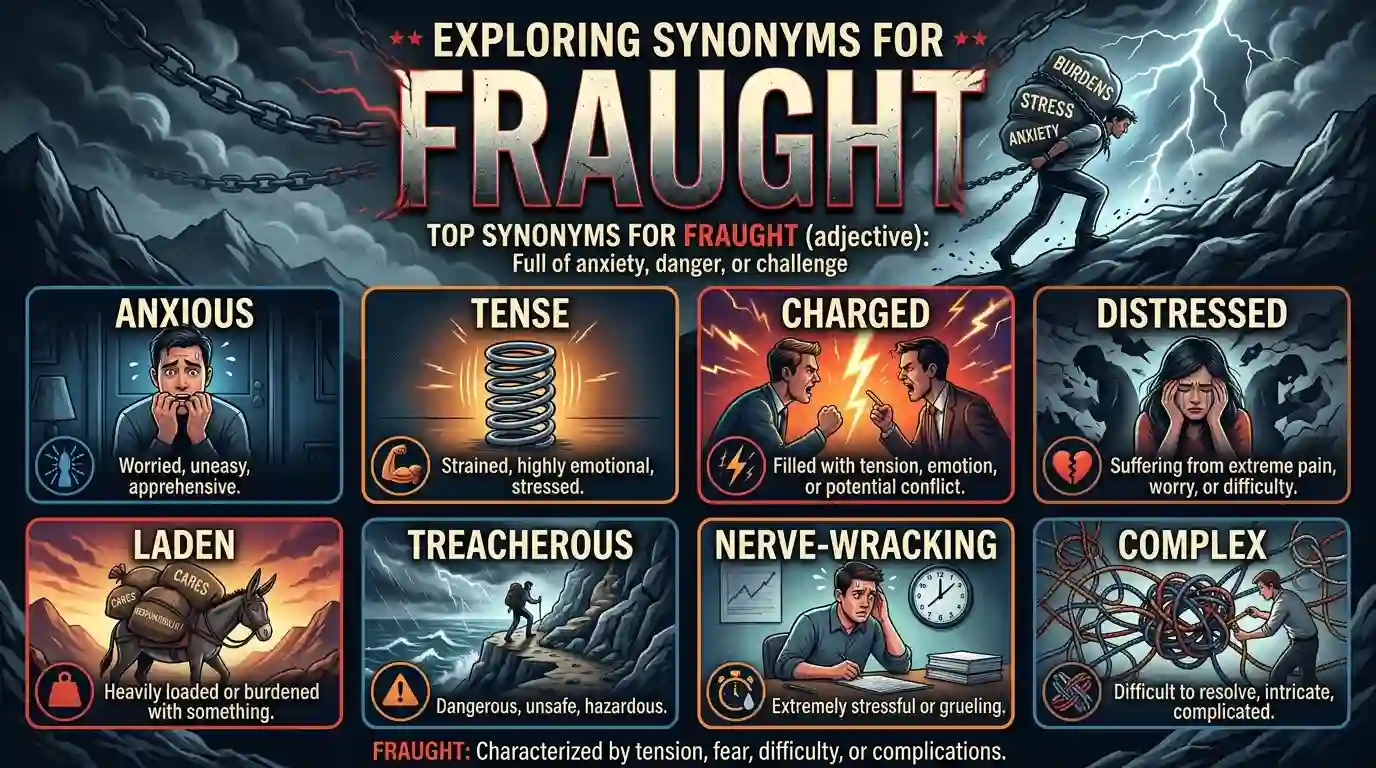
Synonyms for fraught include tense, strained, difficult, anxious, charged, stressful and troubled. The word describes a situation, relationship or moment that feels full of tension, worry or difficulty. It often signals stress, risk or discomfort that builds as circumstances get harder to manage. Writers use it to show emotional weight in conversations, decisions and events.
Table: Synonyms of Fraught
| Fraught | Meaning |
| Worrisome | Causing worry or concern |
| Nerve-wracking | Making someone very anxious |
| Uneasy | Feeling or causing discomfort |
| Precarious | Uncertain and risky |
| Volatile | Likely to change suddenly |
| Sensitive | Easily upset or needing care |
| Taut | Tightly stretched and tense |
| Heavy | Emotionally serious or hard to bear |
Definition of Fraught
- Means full of tension, worry, or difficulty.
- Example: Their talk about money felt fraught with tension.
- Sits high on the stress scale, often used for serious moments rather than mild ones.
- Usually describes relationships, moments, decisions, or silences, as in “fraught relationship,” “fraught silence,” or “fraught decision.”
Etymology of Fraught
- Comes from an old form of the verb “freight,” rooted in Middle Dutch and Old Norse words meaning “to load.”
- Passed through Middle Dutch “vrachten” before it entered English.
- Entered English around the 14th century.
- The original sense of “loaded” is still felt today, since a fraught moment feels loaded with tension.
Word Formation of Fraught
- Root word relates to “freight,” meaning a load or cargo carried by a ship.
- No modern prefix is used; the word grew from an old past-participle form meaning “loaded.”
- The literal sense is “loaded” or “weighed down,” which grew into “filled with tension.”
- Related English words include “freight” and “freighted,” which share the same root meaning of carrying a load.
30 Synonyms for Fraught
1. Tense (Adjective)
Meaning: Filled with strain or nervous pressure.
- The meeting felt tense after the bad news.
- Her voice was tense as she waited for the results.
2. Strained (Adjective)
Meaning: Marked by stress or a lack of ease.
- Their friendship grew strained after the argument.
- He gave a strained smile during the interview.
3. Anxious (Adjective)
Meaning: Full of worry about what might happen.
- She felt anxious before the exam started.
- The whole team seemed anxious during the delay.
4. Stressful (Adjective)
Meaning: Causing mental or emotional pressure.
- Moving to a new city can be stressful.
- The deadline made the week extremely stressful.
5. Charged (Adjective)
Meaning: Filled with strong feeling or tension.
- The room felt charged after the announcement.
- Their conversation grew charged and quiet at once.
6. Troubled (Adjective)
Meaning: Showing signs of worry or difficulty.
- He gave a troubled look at the letter.
- Their troubled history still shapes how they talk.
7. Difficult (Adjective)
Meaning: Hard to handle or manage smoothly.
- It was a difficult decision for the family.
- The talks became difficult near the deadline.
8. Uneasy (Adjective)
Meaning: Not calm or comfortable.
- She felt uneasy walking into the meeting.
- An uneasy silence filled the car.
9. Volatile (Adjective)
Meaning: Likely to change suddenly and unpredictably.
- The market stayed volatile all week.
- Their relationship was volatile and unpredictable.
10. Precarious (Adjective)
Meaning: Uncertain and at risk of going wrong.
- The company was in a precarious position.
- He balanced on a precarious ledge above the street.
11. Sensitive (Adjective)
Meaning: Needing careful or gentle handling.
- It’s a sensitive topic for the whole family.
- She raised the sensitive issue with care.
12. Taut (Adjective)
Meaning: Stretched tight with nervous tension.
- The room stayed taut with silence.
- His shoulders were taut with worry.
13. Heavy (Adjective)
Meaning: Emotionally serious or hard to bear.
- The mood turned heavy after the news.
- It was a heavy conversation for both of them.
14. Worrisome (Adjective)
Meaning: Causing a feeling of worry or unease.
- The report gave worrisome details about sales.
- Her cough sounded worrisome to the doctor.
15. Nerve-Wracking (Adjective)
Meaning: Making someone feel very anxious.
- Waiting for results is always nerve-wracking.
- The final match was a nerve-wracking experience.
16. Turbulent (Adjective)
Meaning: Full of sudden change and disorder.
- They lived through a turbulent period at work.
- The flight hit a turbulent patch of weather.
17. Rocky (Adjective)
Meaning: Unstable and full of ups and downs.
- Their marriage went through a rocky patch.
- The company had a rocky first year.
18. Delicate (Adjective)
Meaning: Requiring careful and gentle treatment.
- It’s a delicate matter to discuss with him.
- She handled the delicate situation with patience.
19. Explosive (Adjective)
Meaning: Likely to burst into anger or conflict.
- The meeting turned explosive after the accusation.
- Their explosive argument shocked the neighbors.
20. Tricky (Adjective)
Meaning: Hard to deal with because of hidden problems.
- Negotiating the contract was tricky.
- It’s a tricky question with no easy answer.
21. Complicated (Adjective)
Meaning: Involving many difficult and tangled parts.
- Their relationship became complicated over time.
- The legal case was far more complicated than expected.
22. Loaded (Adjective)
Meaning: Carrying hidden tension or meaning.
- That was a loaded question to ask her.
- The room felt loaded with unspoken frustration.
23. Weighty (Adjective)
Meaning: Serious and heavy in importance or feeling.
- It was a weighty decision for the board.
- Their weighty silence said more than words.
24. Perilous (Adjective)
Meaning: Full of danger or serious risk.
- The climb grew perilous near the summit.
- They faced a perilous journey through the storm.
25. Risky (Adjective)
Meaning: Involving a real chance of trouble.
- Investing now felt risky to the team.
- It was a risky move for a new business.
26. Edgy (Adjective)
Meaning: Nervous, irritable, and on alert.
- He seemed edgy before the big presentation.
- The whole office felt edgy after the layoffs.
27. Nervous (Adjective)
Meaning: Uneasy and worried about an outcome.
- She was nervous about the job interview.
- His nervous laugh gave away his worry.
28. Unsettled (Adjective)
Meaning: Lacking calm or a clear resolution.
- The dispute left both sides unsettled.
- He felt unsettled after the strange phone call.
29. Overwrought (Adjective)
Meaning: Extremely anxious or emotionally worked up.
- She grew overwrought waiting for news of the flight.
- His overwrought reaction surprised his coworkers.
30. Agonizing (Adjective)
Meaning: Causing severe worry or emotional pain.
- It was an agonizing wait for the test results.
- They faced an agonizing choice between two options.
Antonyms of Fraught
- Calm (Adjective): free from tension or worry.
- Peaceful (Adjective): quiet and free of conflict.
- Relaxed (Adjective): free from stress or pressure.
- Easy (Adjective): simple and free of difficulty.
- Untroubled (Adjective): not affected by worry or problems.
Conclusion
Learning synonyms and antonyms sharpens how clearly you write and speak. A wider vocabulary helps you match the exact tone you need, if that’s calm or tense, simple or serious. This skill makes blog posts, essays, and articles more precise and engaging for readers.
It also helps in daily conversations, where the right word can prevent confusion. Try using a few of these words in your next email or piece of writing to build the habit naturally.

Welcome to Synotwin, your go-to digital platform for the latest breaking news, trending updates, technology insights, and informative articles. We are dedicated to providing accurate, engaging, and well-researched content designed to keep you informed in a fast-paced world.
At Synotwin, we believe that staying updated shouldn’t be complicated. Whether you are looking for current events, digital trends, practical tips, or in-depth analysis, our platform simplifies complex topics into clear, reader-friendly content.
Our Mission Our mission is simple: to deliver reliable and high-quality information that empowers our readers. We strive to maintain absolute transparency, editorial integrity, and continuous updates so that you always get the ground reality first.
What We Cover
-
Breaking News & Top Stories: Real-time updates on global and local trends.
-
Tech & Digital Insights: Practical guides, digital tools, and future innovations.
-
Lifestyle & Ideas: Informative content aimed at solving everyday queries.
Why Choose Synotwin?
-
Accurate & Fact-Checked: We carefully structure and verify our updates before sharing.
-
Reader-Centric Design: Clean layout tailored for smooth reading on mobile and desktop.
-
Always Updated: Fresh content published regularly to match real-time trends.
Thank you for visiting Synotwin. Explore our latest articles, stay informed, and feel free to connect with us through our contact page!