
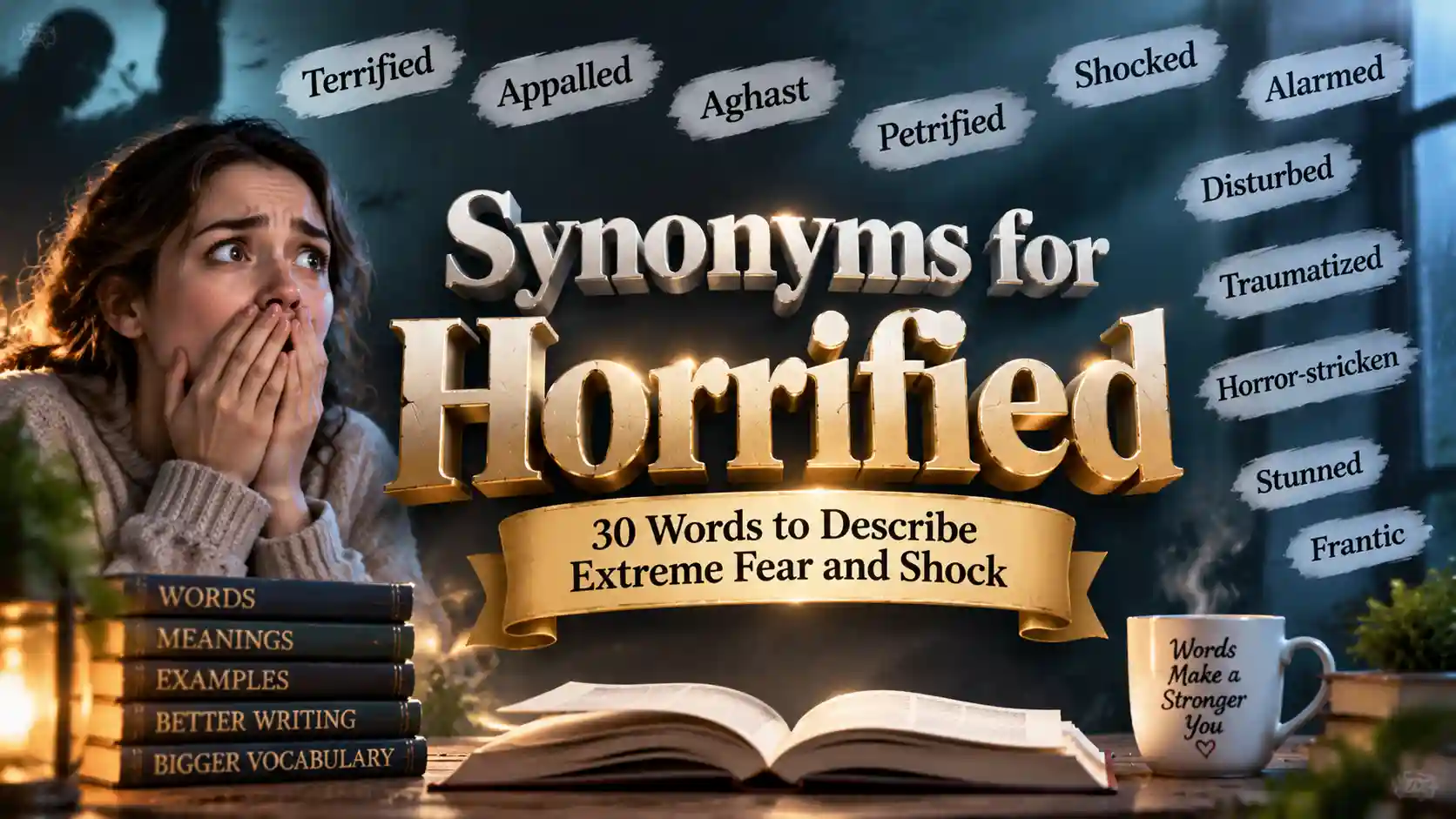
Synonyms for horrified include terrified, shocked, appalled, aghast, stunned, petrified, and repulsed. Horrified means feeling a strong sense of shock, fear, or disgust after seeing or hearing something terrible. This feeling can happen after a real event or while reading a scary story. People often feel this way after an accident, a crime, or something cruel. Writers use these words to show strong emotional reactions in a clear way.
Table : Synonyms of Horrified
| Horrified | Meaning |
| Dismayed | Feeling upset and shocked |
| Disturbed | Feeling troubled and uneasy |
| Mortified | Feeling deep shame and shock |
| Sickened | Feeling disgusted and shocked |
| Alarmed | Feeling sudden fear or worry |
| Traumatized | Feeling shocked after a painful event |
| Scandalized | Feeling shocked by bad behavior |
| Revolted | Feeling strong disgust |
Definition of Horrified
- Horrified means feeling shocked, scared, or disgusted by something terrible.
- Example: The damage after the storm horrified her.
- Intensity: This word shows a strong feeling. It is stronger than “surprised” and close to “terrified.”
- Usage note: It often describes reactions to violence, accidents, or shocking news, such as a “horrified expression,” “horrified silence,” or “horrified gasp.”
Etymology of Horrified
- The word comes from the Latin verb “horrere,” which meant “to bristle” or “to shudder.”
- It passed through French before it reached English.
- It entered English in the 1600s.
- The original sense of shuddering with fear is still present in the word today.
Word Formation of Horrified
- The root word is “horror,” from Latin, meaning “a bristling or trembling with fear.”
- The suffix “-ify” means “to make” or “to cause to become.”
- Together, “horrify” literally means “to cause someone to feel horror.”
- “Horrified” is the past form; something made the person feel horror.
- Other words from the same root include “horror,” “horrific,” and “horrendous.”
30 Synonyms for Horrified
1. Terrified (Adjective)
Meaning: Feeling very strong fear.
- He felt terrified when the lights suddenly went out.
- The child looked terrified during the thunderstorm.
2. Shocked (Adjective)
Meaning: Feeling a sudden, strong surprise mixed with fear or disgust.
- The news of the crash shocked her.
- The sudden news shocked everyone in the room into silence.
3. Appalled (Adjective)
Meaning: Feeling strong disapproval and shock at something wrong.
- The way managers treated the workers appalled me.
- The manager felt appalled after reading the report.
4. Aghast (Adjective)
Meaning: Feeling filled with shock and horror.
- She stood aghast at the size of the damage.
- He felt aghast when he heard the terrible news.
5. Stunned (Adjective)
Meaning: Feeling too shocked to move or speak.
- The explosion stunned the crowd.
- She sat stunned after hearing the sad news.
6. Petrified (Adjective)
Meaning: Feeling so afraid that you cannot move.
- The snake petrified him.
- The scary movie petrified the kids.
7. Repulsed (Adjective)
Meaning: Feeling strong disgust toward something.
- She felt repulsed by the smell of the trash.
- The violent scene repulsed the viewers.
8. Dismayed (Adjective)
Meaning: Feeling upset and shocked by bad news.
- He felt dismayed to learn about the layoffs.
- She felt dismayed at the state of the old house.
9. Disturbed (Adjective)
Meaning: Feeling troubled or uneasy about something.
- The sound from the basement disturbed me.
- The story left many readers feeling disturbed.
10. Mortified (Adjective)
Meaning: Feeling deep shame or shock, often from embarrassment.
- She felt mortified when she tripped on stage.
- He felt mortified after forgetting his lines.
11. Sickened (Adjective)
Meaning: Feeling strong disgust and shock together.
- The cruelty in the video sickened me.
- The report left many readers feeling sickened.
12. Alarmed (Adjective)
Meaning: Feeling sudden fear or worry about danger.
- The loud crash outside alarmed her.
- A sudden alarm at night alarmed the neighbors.
13. Traumatized (Adjective)
Meaning: Feeling deep shock after a painful or scary event.
- The flood traumatized the survivors.
- He felt traumatized after witnessing the accident.
14. Scandalized (Adjective)
Meaning: Feeling shocked by behavior seen as improper.
- His rude comments scandalized the audience.
- She felt scandalized after reading the shocking headline.
15. Revolted (Adjective)
Meaning: Feeling strong disgust toward something unpleasant.
- The state of the kitchen revolted me.
- He felt revolted watching the graphic footage.
16. Frightened (Adjective)
Meaning: Feeling afraid of something.
- The dog looked frightened during the fireworks.
- The strange noise upstairs frightened her.
17. Scared (Adjective)
Meaning: Feeling fear, often suddenly.
- The dark hallway scared the kids.
- He got scared when the phone rang at midnight.
18. Astounded (Adjective)
Meaning: Feeling shocked by something surprising or extreme.
- The extent of the damage astounded me.
- She stood astounded after hearing the terrible story.
19. Stupefied (Adjective)
Meaning: Feeling too shocked to think clearly.
- The sudden bad news stupefied him.
- The crowd stood stupefied after the accident.
20. Horror-Struck (Adjective)
Meaning: Feeling overwhelmed by horror.
- The gruesome scene left her horror-struck.
- The witnesses stood horror-struck after the crash.
21. Spooked (Adjective)
Meaning: Feeling suddenly frightened or unsettled.
- The horse got spooked by the loud thunder.
- I felt spooked walking through the empty house.
22. Unnerved (Adjective)
Meaning: Feeling shaken and losing confidence from fear.
- The strange sound left her unnerved.
- He felt unnerved after the close call on the road.
23. Distressed (Adjective)
Meaning: Feeling deep worry and emotional pain.
- The diagnosis left the family distressed.
- She looked distressed during the long wait for news.
24. Dumbfounded (Adjective)
Meaning: Feeling too shocked to speak.
- The sudden change in plans left him dumbfounded.
- The manager stood dumbfounded after the announcement.
25. Flabbergasted (Adjective)
Meaning: Feeling extreme shock or disbelief.
- The size of the bill flabbergasted me.
- She looked flabbergasted when she heard the results.
26. Panicked (Adjective)
Meaning: Feeling sudden, strong fear that causes quick reactions.
- The passengers panicked when the plane shook.
- He panicked after losing sight of his son in the crowd.
27. Terror-Stricken (Adjective)
Meaning: Feeling overwhelming fear.
- The storm left the villagers terror-stricken.
- She felt terror-stricken when the car skidded on the ice.
28. Chilled (Adjective)
Meaning: Feeling a cold sense of fear or shock.
- The story left me chilled to the bone.
- He felt chilled after hearing the strange howl outside.
29. Disgusted (Adjective)
Meaning: Feeling strong dislike or revulsion.
- The mess in the room disgusted her.
- I felt disgusted watching the cruel scene.
30. Startled (Adjective)
Meaning: Feeling a sudden jolt of surprise and fear.
- The loud knock on the door startled him.
- The cat looked startled when the vacuum turned on.
Antonyms of Horrified
- Calm (Adjective): feeling relaxed and free from fear.
- Pleased (Adjective): feeling happy and satisfied.
- Delighted (Adjective): feeling great joy or pleasure.
- Unfazed (Adjective): not bothered or shocked by something.
- Comforted (Adjective): feeling calm and reassured.
Conclusion
Learning synonyms and antonyms for words like horrified makes writing more powerful and clear. It helps you choose the right word for the right feeling, if you are writing an email, an essay, a blog post, or a story. It also improves speaking skills by giving you more ways to express emotion. Try using a few of these words in your next piece of writing or conversation to build stronger, more natural vocabulary habits.

Welcome to Synotwin, your go-to digital platform for the latest breaking news, trending updates, technology insights, and informative articles. We are dedicated to providing accurate, engaging, and well-researched content designed to keep you informed in a fast-paced world.
At Synotwin, we believe that staying updated shouldn’t be complicated. Whether you are looking for current events, digital trends, practical tips, or in-depth analysis, our platform simplifies complex topics into clear, reader-friendly content.
Our Mission Our mission is simple: to deliver reliable and high-quality information that empowers our readers. We strive to maintain absolute transparency, editorial integrity, and continuous updates so that you always get the ground reality first.
What We Cover
-
Breaking News & Top Stories: Real-time updates on global and local trends.
-
Tech & Digital Insights: Practical guides, digital tools, and future innovations.
-
Lifestyle & Ideas: Informative content aimed at solving everyday queries.
Why Choose Synotwin?
-
Accurate & Fact-Checked: We carefully structure and verify our updates before sharing.
-
Reader-Centric Design: Clean layout tailored for smooth reading on mobile and desktop.
-
Always Updated: Fresh content published regularly to match real-time trends.
Thank you for visiting Synotwin. Explore our latest articles, stay informed, and feel free to connect with us through our contact page!