
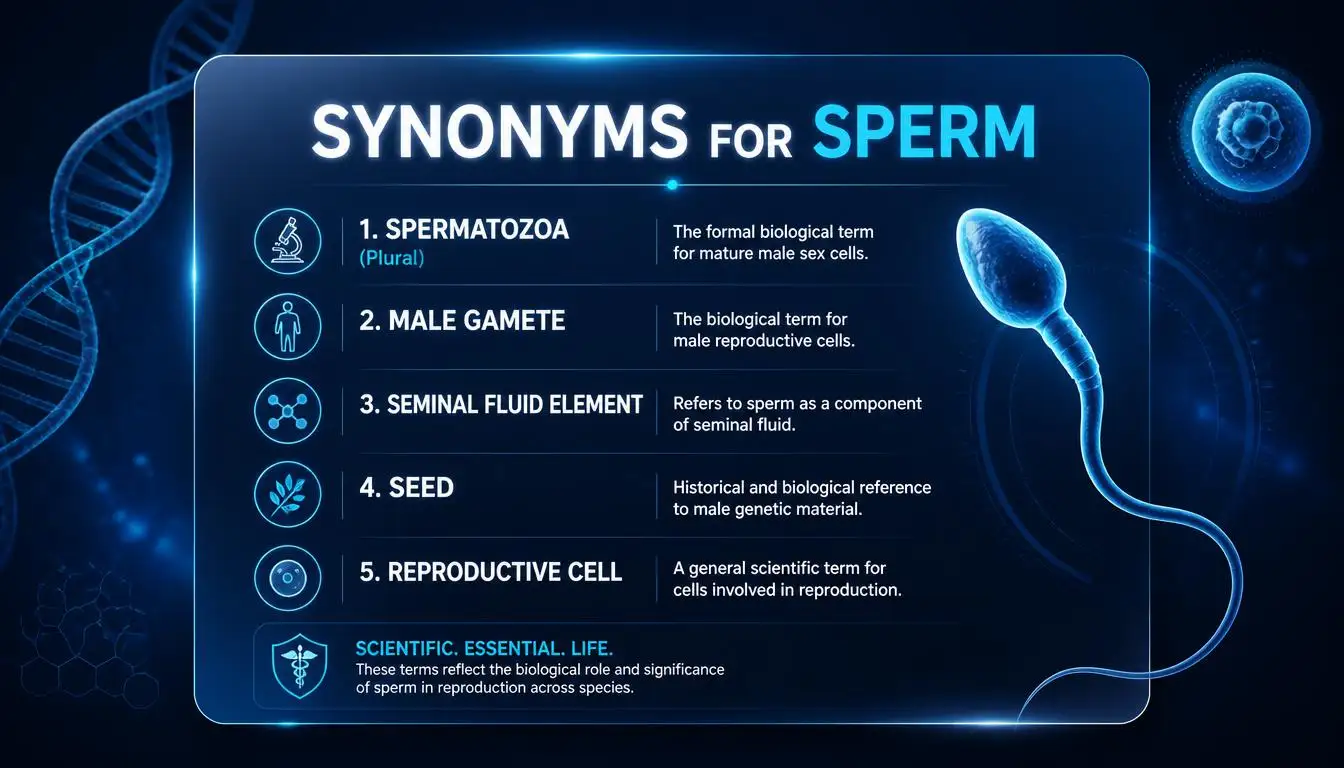
Synonyms for sperm include spermatozoa, seed, male gamete, milt, semen, and germ cell. The word sperm refers to the male reproductive cell responsible for fertilizing an egg during sexual reproduction. Using synonyms for sperm helps medical writers, biology students, and researchers express scientific concepts clearly and accurately in various contexts.
Table: Synonyms of Sperm
| Synonym | Meaning |
| Reproductive cell | Cell responsible for biological reproduction |
| Male seed | Reproductive material produced by males |
| Genetic carrier | Biological structure carrying paternal DNA |
| Fertilizing agent | Microscopic agent that initiates fertilization |
| Spermatozoon | Single microscopic male reproductive cell |
| Gamete | Mature haploid male germ cell |
| Seminal fluid | Fluid carrying male reproductive cells |
| Procreative cell | Cell involved in creating offspring |
Definition of Sperm
- Definition: The male reproductive cell, typically swimming with a tail, that fertilizes the female egg.
- Example Sentence: The biologist examined the swimming movement of the sperm under the microscope.
- Intensity Context: Neutral scientific term widely used in medical, educational, and biological discussions.
- Usage Note: Modifies or combines with biological terms, commonly appearing in phrases like “sperm cell,” “sperm count,” and “sperm motility.”
Etymology of Sperm
- Origin: Derived from Ancient Greek spérma, meaning “seed” or “that which is sown.”
- Intermediate Language: Passed into Late Latin as sperma and then into Old French as esperme.
- Period: Entered the English language during the late 14th century.
- Sense Retention: The primary biological meaning of male seed or reproductive element has been retained through modern science.
Word Formation of Sperm
- Root Word: Sperm (from Greek speirein), meaning “to sow” or “to scatter.”
- Prefix/Suffix: Often acts as a root or combines with Greek suffixes like -zoa (living beings).
- Literal Sense: That which is sown to produce life.
- Related Words: Spermatogenesis, spermatozoon, and endosperm.
30 Synonyms for Sperm
1. Spermatozoa (Noun)
Meaning: The mature male reproductive cells that fertilize female eggs.
- Healthy spermatozoa are necessary for successful fertilization.
- The laboratory test analyzed the motility rate of the spermatozoa.
2. Seed (Noun)
Meaning: The biological material or origin from which life grows.
- Ancient medical texts referred to male reproductive material simply as seed.
- Farmers studied plant fertilization to understand how seed combines with soil.
3. Male Gamete (Noun)
Meaning: The mature male germ cell capable of uniting with a female gamete.
- Each male gamete carries half of the genetic information required for an embryo.
- The diagram shows how a male gamete attaches to the outer wall of the egg.
4. Germ Cell (Noun)
Meaning: A reproductive cell containing genetic material for inheritance.
- A male germ cell develops into a mature swimming unit through several stages.
- Scientists protect germ cells from radiation damage during genetic experiments.
5. Milt (Noun)
Meaning: The male reproductive fluid or cell mass produced by fish and aquatic creatures.
- The marine biologist studied the milt released by salmon during the spawning season.
- Hatchery workers collected milt to ensure controlled breeding of the trout population.
6. Semen (Noun)
Meaning: The fluid containing male reproductive cells and secretions from glands.
- The clinical report measured the total concentration of cells within the semen sample.
- Proper temperature control is vital when storing human semen in sperm banks.
7. Spermatozoon (Noun)
Meaning: A single individual male reproductive cell.
- Only one spermatozoon successfully penetrates the protective layer of the egg.
- High magnification revealed the distinct head and tail structure of the spermatozoon.
8. Biological Seed (Noun)
Meaning: The organic element produced by an organism to initiate generation.
- The biological seed contains paternal DNA necessary to pass down traits.
- Researchers observed how the biological seed responded to changes in chemical balance.
9. Paternal Gamete (Noun)
Meaning: The male sex cell inherited from the father side of offspring.
- Fusion of the paternal gamete with the maternal egg creates a complete genome.
- Testing confirmed that the paternal gamete carried no genetic abnormalities.
10. Fertilizing Unit (Noun)
Meaning: A functional reproductive cell capable of starting embryo development.
- Each fertilizing unit must possess strong mobility to reach its destination.
- Microscopic evaluation confirmed the active state of every fertilizing unit.
11. Genetic Cell (Noun)
Meaning: A cell specialized in transporting hereditary instructions to offspring.
- The male genetic cell transmits chromosomes to the developing zygote.
- Environmental factors can influence the vitality of a male genetic cell over time.
12. Reproductive Cell (Noun)
Meaning: A cell produced by an organism for the purpose of sexual reproduction.
- The human male body continuously produces the specialized male reproductive cell.
- Microscopic studies focus on how a male reproductive cell moves through fluid.
13. Male Sex Cell (Noun)
Meaning: The specialized male haploid cell involved in fertilization.
- Health factors play a major role in the production of a healthy male sex cell.
- Doctors evaluated the overall structure and speed of the male sex cell sample.
14. Procreative Unit (Noun)
Meaning: An individual cellular element that functions in generating new life.
- Every procreative unit relies on energy produced by its middle section.
- The study tracked how temperature shifts affected each procreative unit in the dish.
15. Reproductive Element (Noun)
Meaning: A vital biological component involved in passing life to a new generation.
- The male reproductive element combines its genetic package with the female ovum.
- Advanced microscopy helps scientists monitor the movement of each reproductive element.
16. Male Germ Cell (Noun)
Meaning: An undifferentiated or mature cell dedicated to male lineage reproduction.
- Hormones regulate the growth process of the male germ cell in the testes.
- The medical team isolated the male germ cell for advanced genetic testing.
17. Fertilizing Cell (Noun)
Meaning: A cellular structure designed specifically to enter and fertilize an egg.
- The fertilizing cell uses its tail to travel toward the target location.
- Nutrients in the seminal fluid provide energy to the fertilizing cell.
18. Hereditary Cell (Noun)
Meaning: A reproductive unit that carries ancestral traits from father to offspring.
- The father transmits half of the offspring’s features through his hereditary cell.
- Laboratory techniques ensure the preservation of every active hereditary cell.
19. Spermatic Cell (Noun)
Meaning: A developing or fully formed cell within the male reproductive system.
- Biologists tracked the full maturation cycle of the spermatic cell in animals.
- High stress levels can negatively alter the development of a spermatic cell.
20. Haploid Male Cell (Noun)
Meaning: A male reproductive cell containing a single set of unpaired chromosomes.
- The haploid male cell combines with a haploid egg to form a diploid zygote.
- Meiosis is the cell division process that creates the haploid male cell.
21. Male Seed Cell (Noun)
Meaning: The fundamental unit of male reproductive material responsible for generation.
- Doctors checked the sample to ensure the male seed cell showed healthy motion.
- Proper hydration supports the healthy production of every male seed cell.
22. Motile Gamete (Noun)
Meaning: A moving male reproductive cell equipped for swimming toward fertilization.
- Unlike the stationary egg, the motile gamete actively travels across distances.
- Fluid viscosity directly affects how quickly a motile gamete can advance.
23. Flagellated Cell (Noun)
Meaning: A cell propelled by a whip-like tail structure or flagellum.
- The human male gamete functions as a specialized flagellated cell during reproduction.
- Movement in a flagellated cell requires continuous consumption of energy.
24. Paternal Cell (Noun)
Meaning: A reproductive cell provided by the father during fertilization.
- Traits like eye color can be influenced by DNA inside the paternal cell.
- The clinical team carefully prepared the paternal cell for in vitro procedures.
25. Generative Cell (Noun)
Meaning: A cell involved in generating new organisms or plant structures.
- In flowering plants, the generative cell divides to form male gametes.
- Researchers analyzed the division rate of the generative cell under heat stress.
26. Spermatic Fluid Cell (Noun)
Meaning: A cellular component suspended within male reproductive fluid.
- Centrifugation separates the spermatic fluid cell from surrounding liquid components.
- Pathologists inspect the spermatic fluid cell count to evaluate overall health.
27. Male Reproductive Unit (Noun)
Meaning: A single biological entity responsible for male fertility and genetic transfer.
- Every male reproductive unit contains a head packed with condensed genetic material.
- Clinical trials monitored how supplements improved each male reproductive unit.
28. Fertilization Cell (Noun)
Meaning: A functional male cell specialized for binding with and penetrating an egg.
- Enzymes on the tip of the fertilization cell break down the outer layer of the egg.
- Microscopic recording documented the exact moment the fertilization cell entered.
29. Biological Male Gamete (Noun)
Meaning: The natural male reproductive cell carrying paternal hereditary factors.
- A healthy biological male gamete exhibits consistent forward progress.
- Geneticists sequenced the DNA contained inside the biological male gamete.
30. Procreative Cell (Noun)
Meaning: A specialized cell responsible for generating offspring in living beings.
- Protection from toxic chemicals helps preserve the integrity of the procreative cell.
- Studies show that diet can influence the structural health of a procreative cell.
Antonyms of Sperm
- Ovum (Noun): The female reproductive cell or egg that combines with sperm.
- Egg Cell (Noun): The mature female gamete involved in sexual reproduction.
- Oocyte (Noun): An immature female reproductive cell before complete development.
- Female Gamete (Noun): The female haploid cell responsible for receiving fertilization.
- Somatic Cell (Noun): Any non-reproductive body cell that does not form gametes.
Conclusion
Understanding various synonyms for sperm enhances clarity and precision in scientific, medical, and educational contexts. Using alternative terms like male gamete, spermatozoa, or germ cell allows writers to match the tone of academic papers, medical reports, and biology articles.
Mastering this specialized vocabulary improves overall communication and helps convey accurate biological details. Practice applying these synonyms and antonyms in your essays, research papers, and technical discussions to sharpen your vocabulary skills.

Welcome to Synotwin, your go-to digital platform for the latest breaking news, trending updates, technology insights, and informative articles. We are dedicated to providing accurate, engaging, and well-researched content designed to keep you informed in a fast-paced world.
At Synotwin, we believe that staying updated shouldn’t be complicated. Whether you are looking for current events, digital trends, practical tips, or in-depth analysis, our platform simplifies complex topics into clear, reader-friendly content.
Our Mission Our mission is simple: to deliver reliable and high-quality information that empowers our readers. We strive to maintain absolute transparency, editorial integrity, and continuous updates so that you always get the ground reality first.
What We Cover
-
Breaking News & Top Stories: Real-time updates on global and local trends.
-
Tech & Digital Insights: Practical guides, digital tools, and future innovations.
-
Lifestyle & Ideas: Informative content aimed at solving everyday queries.
Why Choose Synotwin?
-
Accurate & Fact-Checked: We carefully structure and verify our updates before sharing.
-
Reader-Centric Design: Clean layout tailored for smooth reading on mobile and desktop.
-
Always Updated: Fresh content published regularly to match real-time trends.
Thank you for visiting Synotwin. Explore our latest articles, stay informed, and feel free to connect with us through our contact page!