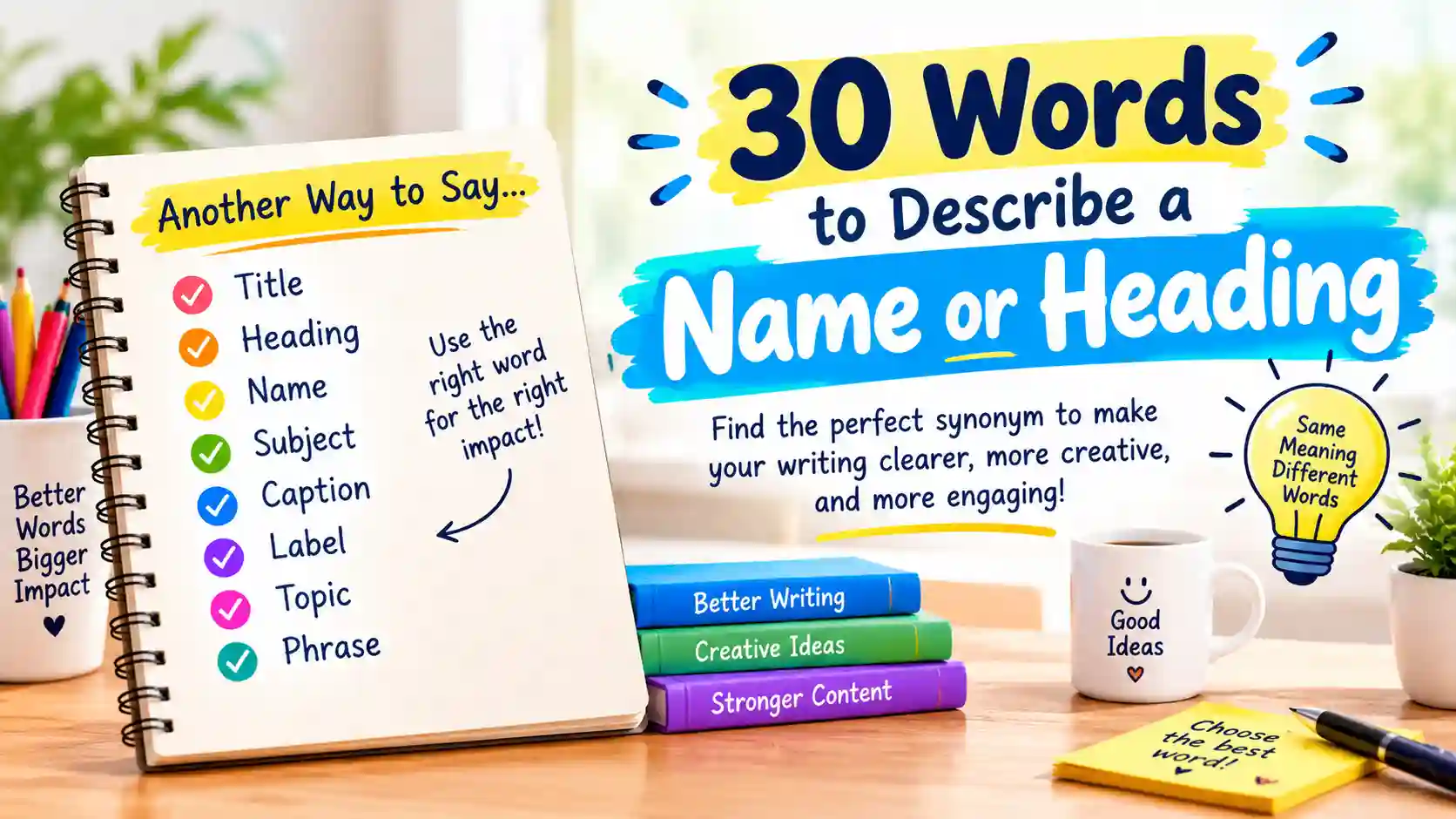
Synonyms for title include name, heading, headline, caption, label, header and tag. A title is the name given to a book or a film or a song. It tells people what the work is about. This guide shares 30 easy words you can use instead.
Table: Synonyms of Title
| Synonym for Title | Meaning |
| Banner | A big heading across the top |
| Subtitle | A second title after the main one |
| Subheading | A small heading inside a text |
| Designation | An official name |
| Moniker | A name people use for something |
| Handle | A short name used online |
| Masthead | The title at the top of a paper |
| Tagline | A short phrase near a title |
Definition of Title
- Definition: A title is the name of a book or a film or a song.
- Example: The title of my new book is The Little Red Fox.
- Usage level: Title is a plain and neutral word. It is not too formal or too casual. You can use it at school and at work.
- Usage note: Title describes the name of a work. It fits books and films and songs and articles. Common phrases are book title, song title and movie title.
Etymology of Title
- Origin: Title comes from the Latin word titulus. It meant a label or an inscription.
- Other languages: The word passed through Old French and Old English before it became the word we use today.
- Time period: It entered English about a thousand years ago.
- Original sense: The old sense lives on. A title is still a name or a label placed on something.
Word Formation of Title
- Root word: The root is titulus. It means an inscription or a label.
- Prefix or suffix: Title has no prefix or suffix in English. It is a base word.
- Literal sense: The full word still means the name written on a thing.
- Related words: Entitle and subtitle and retitle share the same root. So do titular and untitled.
30 Synonyms for Title
1. Name (Noun)
Meaning: A word that tells what a book or a film or any work is called.
- The name of the movie made us laugh.
- Please write the name of your story at the top.
2. Heading (Noun)
Meaning: A title at the top of a page or a part of a text.
- Each part of the chapter has a clear heading.
- She wrote the heading in big letters.
3. Headline (Noun)
Meaning: The title of a news story shown at the top.
- The headline said our school won the game.
- I read the headline before the story.
4. Caption (Noun)
Meaning: A short title or line under a picture.
- The caption told us who was in the photo.
- He wrote a funny caption for the drawing.
5. Label (Noun)
Meaning: A small word or note that names something.
- The label on the jar says honey.
- Every box has a label on the front.
6. Tag (Noun)
Meaning: A short name used to mark or sort things.
- She put a tag on each file.
- The blog post has a tag called travel.
7. Header (Noun)
Meaning: A title at the top of a page or a section.
- The page header shows the name of the book.
- Add a header to the top of the sheet.
8. Banner (Noun)
Meaning: A big title across the top of a page or a sign.
- The banner on the site shows the name of the show.
- A bright banner hung over the stage.
9. Subheading (Noun)
Meaning: A small title inside a text under a main heading.
- Each subheading makes the article easy to read.
- Add a subheading above the second paragraph.
10. Subtitle (Noun)
Meaning: A second title that comes after the main title.
- The book has a long subtitle under the main name.
- The subtitle tells more about the story.
11. Designation (Noun)
Meaning: An official name given to something.
- The new road got the designation Route 5.
- Each room has its own designation.
12. Appellation (Noun)
Meaning: A formal word for a name or title.
- The old map gave the town a new appellation.
- He was known by the appellation the Wise.
13. Moniker (Noun)
Meaning: A name that people use for someone or something.
- The moniker of our team is the Tigers.
- Her moniker at school was Sunny.
14. Handle (Noun)
Meaning: A short name used for an online account.
- Pick a handle for your new account.
- His handle on the game site is StarKid.
15. Term (Noun)
Meaning: A word or phrase used as a name for something.
- Kitten is the term for a baby cat.
- Teachers use the term chapter for a part of a book.
16. Epithet (Noun)
Meaning: A word or phrase added to a name to describe it.
- The hero earned the epithet the Brave.
- An epithet tells what a person is like.
17. Identifier (Noun)
Meaning: A word or code that names something so you can find it.
- Each file needs its own identifier.
- The identifier for the book is on its spine.
18. Inscription (Noun)
Meaning: Words written or carved on something as its title or label.
- The inscription on the statue named the hero.
- A short inscription sat above the door.
19. Legend (Noun)
Meaning: A short title or note that explains a picture or a map.
- The legend on the map shows what each color means.
- Read the legend before you use the chart.
20. Rubric (Noun)
Meaning: A heading or title for a part of a text.
- The teacher put each topic under its own rubric.
- A red rubric marked the start of the section.
21. Masthead (Noun)
Meaning: The title of a newspaper shown at the top of the front page.
- The masthead shows the name of the paper.
- Our school paper has a new masthead.
22. Tagline (Noun)
Meaning: A short phrase placed near a title to tell more.
- The tagline of the film made us want to see it.
- Write a tagline under the name of your shop.
23. Slug (Noun)
Meaning: A short title a newsroom uses to name a story.
- The editor gave the story a short slug.
- The slug for the story was storm-news.
24. Subject Line (Noun)
Meaning: The title of an email that shows what it is about.
- Write a clear subject line for your email.
- A good subject line gets more people to open it.
25. Nameplate (Noun)
Meaning: A small sign that shows a name.
- The nameplate on the desk shows her name.
- A shiny nameplate hung on the door.
26. Nickname (Noun)
Meaning: A friendly name used in place of a real name.
- His nickname is Sparky.
- Dad gave the puppy a funny nickname.
27. Sobriquet (Noun)
Meaning: A fancy word for a nickname used as a name.
- The player earned the sobriquet Lightning for his speed.
- The old pirate was known by the sobriquet Redbeard.
28. Name Tag (Noun)
Meaning: A small label that shows a person’s name.
- Please wear your name tag at the party.
- Her name tag said Maya.
29. Headword (Noun)
Meaning: A word set at the top of an entry as its title.
- Each dictionary entry begins with a headword.
- The headword is shown in bold.
30. Alias (Noun)
Meaning: Another name used in place of a real one.
- The author wrote under an alias.
- He signed the note with an alias.
Antonyms of Title
- Untitled (Adjective): having no title or name.
- Nameless (Adjective): without any name.
- Unnamed (Adjective): not given a name yet.
- Anonymous (Adjective): having no known name.
- Body (Noun): the main part of a text after the title.
Conclusion
Learning synonyms and antonyms helps you write and speak with more power. You do not need to use the same word again and again. You can pick the best word for each job. This helps in blogging and school work and daily talk.
Try new words in your emails and essays and articles. Use them in chats with friends too. Each new word makes your voice clearer and more fun. Keep practicing and your skills will grow.

Welcome to Synotwin, your go-to digital platform for the latest breaking news, trending updates, technology insights, and informative articles. We are dedicated to providing accurate, engaging, and well-researched content designed to keep you informed in a fast-paced world.
At Synotwin, we believe that staying updated shouldn’t be complicated. Whether you are looking for current events, digital trends, practical tips, or in-depth analysis, our platform simplifies complex topics into clear, reader-friendly content.
Our Mission Our mission is simple: to deliver reliable and high-quality information that empowers our readers. We strive to maintain absolute transparency, editorial integrity, and continuous updates so that you always get the ground reality first.
What We Cover
-
Breaking News & Top Stories: Real-time updates on global and local trends.
-
Tech & Digital Insights: Practical guides, digital tools, and future innovations.
-
Lifestyle & Ideas: Informative content aimed at solving everyday queries.
Why Choose Synotwin?
-
Accurate & Fact-Checked: We carefully structure and verify our updates before sharing.
-
Reader-Centric Design: Clean layout tailored for smooth reading on mobile and desktop.
-
Always Updated: Fresh content published regularly to match real-time trends.
Thank you for visiting Synotwin. Explore our latest articles, stay informed, and feel free to connect with us through our contact page!